Affiliate links on Android Authority may earn us a commission. Learn more.
Samsung is about to prove it’s still one of the most exciting Android brands around
Jul 20, 2026 — 6:30 AM ET



Phone launches no longer feel as special, exhilarating, or enthralling as they once did. The slab phone has long been boring, and to make matters worse, heavyweight brands such as Apple, Google, and Samsung often limit “new” product launches to minimal hardware or software changes. Samsung’s last Unpacked was a prime example of this, where our interest hung by a loose thread on the Galaxy S26 Ultra’s Privacy Display. Sure, there were useful improvements to the other two S26 phones, but they weren’t anything close to spellbinding.
This Unpacked feels different because, in addition to routine upgrades for the Galaxy Z Fold 7 and Flip 7, Samsung is bringing an entirely new product — one that could, hopefully, expand into a product line. The star of the show is Samsung’s new wider Fold 8. Adding to its glory are a few tiny but meaningful enhancements that make this one of the most exciting Samsung Unpacked events in many years.
Out of all the different things to expect from Samsung at the Unpacked on July 22 in London, here are my top four picks that make the event far more riveting than previous ones.
Which product from Samsung's upcoming lineup at the Unpacked excites you the most?
The wide Fold feels like the return of proper small phones

For years now, the smartphone world has been bereft of a suitable and branded option for a small phone. The so-called small phones we get today have screens bigger than 6 inches. And to me, an unc born in the early 90s and who spent his teenage and early 20s considering 5-inchers “big phones,” it still doesn’t sit right. Options like the OnePlus 13T or the vanilla Galaxy S26 do satisfy the need for a small, sometimes light footprint, but may lag in performance or struggle to meet your entertainment needs without gasping for breath.

This is one problem I expect the new, “wide” Galaxy Z Fold 8 to solve. The new foldable has been rumored (and leaked) to come in a passport-shaped form factor, with a 5.5-inch outer display and a 7.6-inch inner display. The outer screen is said to have a (now) less prevalent 4:3 aspect ratio.
Since it’s far from the taller aspect ratios (18:9 or higher) on modern devices, some letterboxing is expected on content. But beyond videos and games, this should provide ample space for apps to adapt. In addition to the standard portrait orientation, the extra width should also enhance the landscape mode.
The wide Galaxy Z Fold 8 could address my gripes with a regular Fold.
Additionally, we can expect this wider-than-usual outer screen to give the inner screen more usable space for video. Compare this to a standard book-style foldable, such as the Fold 7 or the expected Fold 8 Ultra, and you’ll notice the wider Fold 8 wastes less space in letterboxing. And this should enhance visibility for both games and videos.
When held open in landscape orientation, the inner screen should have a nearly 3:2 aspect ratio. Flip it by 90º, and you should have a screen size and shape similar to a handy Kindle, better for reading books or long articles online. That’s much more efficient than the unusual 11:10 inner screen aspect ratio on the previously standard (now Ultra) Fold.

While there are no leaks (yet) about whether Samsung plans new software features to better use the new aspect ratio, I expect the design alone to use space more efficiently.
And despite all of this, the wider Fold 8 is expected to be thinner than 5mm (when unfolded) and weigh just 200 grams. These properties make for textbook dream-phone proportions.
Snapdragon is returning for the Flip

Last year, Samsung broke a longstanding tradition by bringing an Exynos-powered flagship to the US. That flagship was the Galaxy Z Flip 7, which came in just one variant powered by Samsung’s Exynos 2500. This year, however, the Flip 8 is likely to return to using the latest-gen Qualcomm chip, specifically the Snapdragon 8 Elite Gen 5. That is likely to hold true at least for the US, even as certain other markets may still get the Exynos treatment.
What are Flip 8 owners with a Snapdragon chip inside rather than an Exynos set to gain, you might ask? Even though the newer Exynos 2600 is both more powerful on paper and more efficient, the Snapdragon Elite chip has proven its mettle in real-world testing. The Exynos, despite a new built-in radiator block, also runs hotter than the Snapdragon 8 Elite Gen 5 (both tested on the Galaxy S26 phones). This is expected to give the Snapdragon-powered variants a slight edge. But apart from that, years of trauma from using Exynos devices may also influence the decision for some buyers.
I still have trust issues with Exynos, and I'm glad Snapdragon is here to save the Flip.
Now, since the Flip has much less space to accommodate passive cooling solutions than a regular slab phone, some heat build-up is also expected from the 8 Elite Gen 5, but hopefully to a lesser degree than it would have been with the Exynos 2600. The extent of throttling is definitely worth checking out once we have had the Flip 8 for a few days.
Rumors suggest this would be the last Flip Samsung makes, as it switches focus to the wider Fold. Given that we’ve seen Samsung’s hardware plans change just months ahead of launch, it’s difficult to determine with confidence how much truth there is to that assumption. But even if there’s a sliver of truth in it, I’m glad (at least some) buyers of the Flip will get the performance and reliability they pay for, with a commitment to longevity.
Watches pick up some more power

While the new foldables are expected to receive a performance boost, new watches aren’t being left behind either. With this generation of the Galaxy Watch, Samsung is bidding farewell to its Exynos chips for watches, too, in favor of the recently unveiled Snapdragon Wear Elite platform. The alliance was first announced at MWC 2026.
Samsung has already been teasing better AI-powered insights on the upcoming Galaxy Watch models — which, as leaked, are the Watch 9 and the Watch Ultra 2. Meanwhile, Qualcomm’s new platform for wearables is especially designed with AI in mind. That’s because it’s the first non-Apple chip for wearables to have a dedicated neural processing unit (NPU).
Your phone gets one neural unit. The new Galaxy Watch gets two.
It not only gets one but two NPUs — the secondary one primarily comes in handy for low-power applications, such as continuous hotword sensing, gesture recognition, and ambient noise suppression.
Meanwhile, the primary Hexagon NPU is set to handle more intensive processing, with a claimed performance of up to 12 TOPS. Qualcomm further claims that the NPU can run on-device AI models and process information from multiple data streams. That ties into Samsung’s teaser, which says multiple data points will be merged to give you a more holistic picture of your health rather than metrics shown in isolation.

Even though we’ve yet to see claims play out in real life — and we will reserve our judgment until we conclude those tests — the likelihood of getting actual, useful AI features right on the wrist is encouraging and hope-giving.
In addition to better AI capabilities, the platform also natively supports NTN, enabling satellite connectivity — a first for the Galaxy Watch lineup. The chip also supports 5G RedCap (Reduced Capability), which, if enabled, could make the Galaxy Watch 9 and the Ultra 2 the first Wear OS devices to move beyond 4G. These two are admittedly long shots, and Samsung may not enable them.
Besides performance improvements, the Galaxy Watch Ultra is also rumored to receive a substantial battery upgrade. The Watch Ultra 2 is rumored to feature an 800mAh battery, marking a straight-up 35% hike over the first-gen Ultra. If that’s true, those using it conservatively could easily extract up to a week from the watch.
Galaxy Watch Ultra 2 could snag the most impactful upgrades.
My Galaxy Watch Ultra currently offers about two days of battery life with the always-on display (AOD) on for 16 hours each day, automatic GPS tracking when I’m walking outside, LTE or Wi-Fi continuously running, and occasional use as a media player without earbuds. I can easily imagine getting more than three days with the larger battery in the upcoming model, making the Galaxy Watch Ultra 2 the most formidable Wear OS watch for longevity. The sturdy look and high water resistance already contribute to that image.
But in addition to hardware, software is also expected to get some stage time at Unpacked next week. And the hero of the announcement could be Samsung’s next major milestone in software: One UI 9.
One UI 9 feels like a big upgrade, at least visually

The shift from Android 16 to Android 17 may have felt like one of the most somber updates for Pixel owners, at least aesthetically. Even though the update focuses more on internal upgrades and some spirited, useful features, such as app bubbles, green-screen reactions in video recording, and a gamepad for foldables, it lacks any major visual inflection.
One UI 9, too, doesn’t get a complete overhaul, but rather tiny improvements over One UI 8.5, which built upon One UI 8. The customization options for quick settings have evolved to give users more control; the menus have been slightly readjusted, and transparency elements have been simply retouched. Despite these small changes, One UI 9 feels visually fresher than ever.
There are other minor functional improvements, such as combined calling history across multiple communication apps, stricter security controls, enhanced home screen customization, and an easy way to keep tabs on sideloaded apps. These could be complemented with a few curious additions, such as driving insights and a more energetic media player.
And the most exciting bit of them all? One UI 9 will not be limited to newer phones only; it will reach a wide range of Samsung Galaxy devices, even though some devices may not have all the features. What would have made it better, perhaps, is if Samsung had released One UI 9 for a good chunk of devices rather than keeping it limited to the newer ones.
Along with One UI 9 for phones, there’s a small chance we will also witness a parallel update for the watches, based on Wear OS 7.
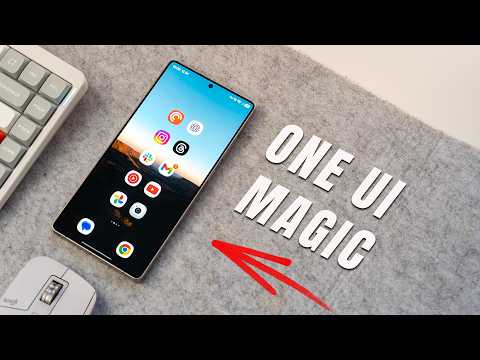
On that note, it’s also important to keep in mind that Samsung hasn’t been teasing One UI 9 as much as it has been teasing the new devices. There’s a very slim chance it may choose to skip One UI 9 at Unpacked and reserve it for later. By doing so, it would break yet another tradition and possibly make this event slightly less exciting.
However, it wouldn’t be able to completely rob this Unpacked and the three other arousing announcements of the excitement they’ve already built up.
Thank you for being part of our community. Read our Comment Policy before posting.