Affiliate links on Android Authority may earn us a commission. Learn more.
5 smartphones that show how far behind the Pixel 11's Tensor G6 really is
Sep 7, 2026 — 5:00 AM ET
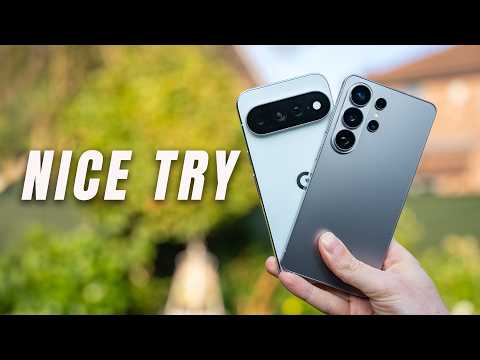


Google has spent years telling us that Tensor is about more than chasing benchmark scores. And that’s fair; a phone’s processor is about AI, photography, connectivity, battery life, and all the clever features that make a Pixel a Pixel.
But there’s a point where the performance gap becomes too large to ignore, particularly when we’re talking about $1,000-plus flagship phones. The Pixel 11 series has some genuinely impressive tricks up its sleeve, but its Tensor G6 processor is increasingly looking like the weakest link.
The problem isn’t simply that rival phones are faster. It’s that they’re much faster, offer longer battery life, and sometimes cost far less than Google charges. Even though the Pixel 11 series is fresh out of the gate, rival phones already on the market make the Tensor G6 feel outdated.
Which of these makes your Pixel run the hottest?
iPhone 17 — that’s how to build custom silicon

If you want to talk raw performance, plenty of flagships surpass the Pixel 11 series across a raft of benchmarks, and the phone comes in a considerable distance behind the US top-seller, the iPhone 17 series. Apple’s custom silicon project, with the A19 and A19 Pro being the latest, makes the Tensor project look positively glacial across popular benchmark tests.
The iPhone 17 Pro and Pro Max’s CPU scores clock in up to 43% faster in single-core and 35% faster in multi-core scenarios, while Apple’s custom GPU obliterates Google’s partnership with Imagination Technologies, scoring up to 73% faster in GPU benchmarks. While Google might like to consider its Pixel lineup in the same flagship sphere as the iPhone, given that it also designs its own chips, it’s clear that Apple’s end-to-end control over CPU, GPU, AI acceleration, and increasingly modem capabilities is helping it build far higher-performance, yet still fully customized flagships.
Samsung Galaxy S26 Ultra — Qualcomm’s lead isn’t going anywhere

When it comes to buying off-the-shelf, the Samsung Galaxy S26 series is Google’s biggest Android competitor in the US market, and its Qualcomm Snapdragon 8 Elite Gen 5 for Galaxy variant absolutely flies past the Tensor G6, whether you’re looking at CPU metrics in GeekBench or GPU performance in 3DMark.
The raw numbers are rather grim for Pixel fans to parse. Qualcomm’s highly clocked, custom Oryon CPU cores still lead the Arm C1 series, delivering a 36% lead in single-core performance and a 53% lead in multi-core performance. That translates to more responsive apps and much more headroom for multitasking across demanding workloads, such as running an Android desktop environment.

Graphics performance is even more glaring: the Galaxy S26 Ultra delivers more than double the raw GPU performance of the Pixel 11 Pro XL (136% higher). While that doesn’t necessarily mean double the frame rate in real games, it does mean a lot more headroom for smooth frame rates and higher graphics settings.
And that’s not just a benchmark extrapolation; I’ve extensively tested both brands over the past 24 months and more, and the conclusion is definitive: Galaxy has far more graphics brawn than the latest Pixels. You can play games with far higher frame rates and more impressive graphics settings on Snapdragon than on Tensor, and emulators benefit too, with smoother frame rates and fewer janks. In addition, Tensor’s PowerVR GPU continues to miss out on ray tracing and other cutting-edge graphics API techniques that drive future gaming experiences.
Samsung Galaxy 25 FE — better gaming on a budget

Sticking with the Samsung theme for a moment, you don’t have to spend top dollar to buy a Galaxy phone that can outpace the latest Pixel flagships. Last year’s Samsung Galaxy S25 FE, sporting a rather modest 2024-era Exynos 2400, still manages to beat the latest Pixel 11 series and its Tensor G6 processor in graphics performance. The lead is obviously not as large as the flagship Galaxy S26 tier, but 26% in 3DMark’s Wild Life Extreme can be the difference between
The Tensor G6’s newer CPU cores actually have a slight lead over Samsung’s older chip, around 5% in multi-core scores and 22% in single-core scores. So it’s not a slam dunk for Samsung’s mid-ranger, but the price and gaming gap does highlight just how far behind Google’s platform has become when it comes to graphics capabilities.

While we haven’t tested it yet, the new Galaxy S26 FE will sport a newer, more powerful Exynos 2500 that’ll widen the lead over the Tensor in all respects. $699 for more general-purpose and gaming performance than the $1,299 Pixel 11 Pro XL sounds like an incredibly good deal for those looking for future-proof performance without breaking the bank.
OnePlus 15R — China’s uncompromising mid-rangers

Sticking with the mid-range theme for a moment, 2026 has seen cut-down chipsets hit the market, offering impressive performance and AI capabilities at sub-flagship prices. Qualcomm’s Snapdragon 8 Elite Gen 5V and Snapdragon Gen 5 are among the highest-profile releases, offering many of the Elite platform’s best features at a lower price point.
Phones like the OnePlus 15R, which sports the regular 8 Gen 5 chipset and a very friendly $700 tag. Qualcomm’s more affordable processor still comes with its Hexagon NPU for AI number crunching, albeit with half as many scalar units as the Elite model. It sports Bluetooth 6 and Wi-Fi 7 pre-certification, something Tensor does not, along with satellite integration.
Of course, these features aren’t supported in all devices, including the OnePlus 15R, but it’s an impressive feature set nonetheless. And I don’t want to keep harping on about benchmarks, but, as I’m sure you’ve guessed, the OnePlus 15R beats the Pixel 11 Pro XL as well. Graphics performance is up by 49%, while CPU benchmarks are 7% and 25% higher for single- and multi-core scores, respectively.
Of course, the Pixel 11 series offers more features and some better hardware than China’s mid-rangers. However, when it comes to the chipset choice, it’s hard not to feel that Google could build more performant models even if it picked a modest but modern piece of silicon from MediaTek or Qualcomm.
Samsung Galaxy Z Fold 7 — superior endurance from older hardware

Of course, silicon isn’t just about raw performance; it’s an important contributor to a phone’s battery life, especially when running demanding workloads or streaming data over your network. In the Pixel 11 Pro Fold’s restrictive form factor, which has just a 4,800mAh cell to power its huge display, efficiency in daily workloads really matters. Motorola and Samsung are forging ahead with silicon-carbon technology to boost the capacity of their latest flagship foldables, so for a fairer contest, I took a look at last year’s Galaxy Z Fold 7, and the results aren’t great.
Samsung’s last-gen foldable has a smaller 4,400mAh battery but still manages longer screen-on times in our 4K playback, camera capture, web browsing, and Zoom call tests. The Pixel 11 Pro Fold comes in anywhere between a rather benign 5% and a clearly noticeable 30% less screen-on time, depending on the test in question.

While the processor is just a part of a phone’s overall battery drain, consumers have long had concerns over Pixel battery drain issues, and the latest Tensor chip doesn’t appear to have helped the series catch up with the competition here.
Hope for the Tensor G7?

None of this means the Pixel 11 series is a bad phone, nor does Tensor suddenly make Google’s flagship lineup unusable. Google’s approach still has clear advantages, particularly around on-device AI and the tight integration between its silicon and software. But those strengths don’t exist in a vacuum anymore. Qualcomm is packing increasingly capable AI hardware into chips that also deliver substantially more CPU and GPU performance, while Apple continues to show what can happen when one company controls virtually every layer of the platform.
That leaves the Tensor G7 with a pretty substantial mountain to climb. Google doesn’t necessarily need to beat Apple’s A-series or Qualcomm’s Snapdragon chips in every benchmark, but it does need to close the gap enough that consumers aren’t paying flagship prices for demonstrably weaker hardware.
After several generations of Tensor, the argument that raw performance doesn’t matter is becoming harder to make. At some point, Google’s custom silicon project needs to deliver both the Pixel experience and the performance to match it.
Thank you for being part of our community. Read our Comment Policy before posting.