Affiliate links on Android Authority may earn us a commission. Learn more.
I checked out the Pixel 10a, and Google played it 'Berry' safe
Google has launched the Pixel 10a as its annual mid-range contender for the crown of the best phone under $500 — a title that’s becoming harder to earn every year. As always, Google’s A series phone has a very straightforward pitch: bring flagship Pixel intelligence and camera prowess to a price point that doesn’t feel flagship at all. But in 2026, when rivals are pushing bigger batteries, faster charging, and more ambitious camera hardware at similar prices, can Google’s A series still dominate by sticking to a tried and tested winning formula? Or does it risk falling behind? I went hands-on with the device at Google’s office in Taipei, Taiwan, to get an early sense of how this year’s mid-range Pixel stacks up.
Google Pixel 10a: Hot or not?
What’s new in the Pixel 10a?

That’s a very good question, and the answer is simple: not a lot. The Pixel 10a builds on the solid foundation laid down by the Pixel 9a, which, by the way, was an excellent $499 phone. Think of the 10a as a refined version of the 9a, so much so that when put together side-by-side, it’s extremely hard to tell the difference between the two phones.
The 10a even shares the same Tensor G4 processor as the Pixel 9a, marking the first time Google has not given a Pixel A series phone the same processor as its flagship counterparts. Unfortunate, for sure, but it’s not difficult to see why Google may have had to make this call (more on that later).
That said, the Pixel 10a brings a number of subtle, under-the-hood changes that are worth noting if you’re considering buying the phone.
A brighter display and tougher build

The Pixel 10a sticks with a 6.3-inch Actua pOLED panel with a 60-120Hz refresh rate, but Google says it’s now up to 11% brighter than the Pixel 9a, hitting up to 3,000 nits peak brightness. In my brief time with the device under Taipei’s bright sun streaming in from a large window where I got to see the Pixel 10a for the first time, the bump in brightness was noticeable, not dramatically so, but just a touch.
Google has upgraded the Pixel 10a's front to Corning Gorilla Glass 7i.
Durability is a bigger talking point this year. While the Pixel 10a is once again IP68 rated for dust and water resistance, Google has upgraded the phone’s front to Corning Gorilla Glass 7i, a welcome upgrade from the Gorilla Glass 3-clad Pixel 9a. That means the Pixel 10a’s display is now capable of surviving drops of up to 1m onto rough surfaces like asphalt. The plastic back cover is no doozy either. In fact, at Google’s Pixel Labs in Taiwan, I got to see the Pixel 10a go through a ball-drop test and a tumble test, and it survived both with grace.
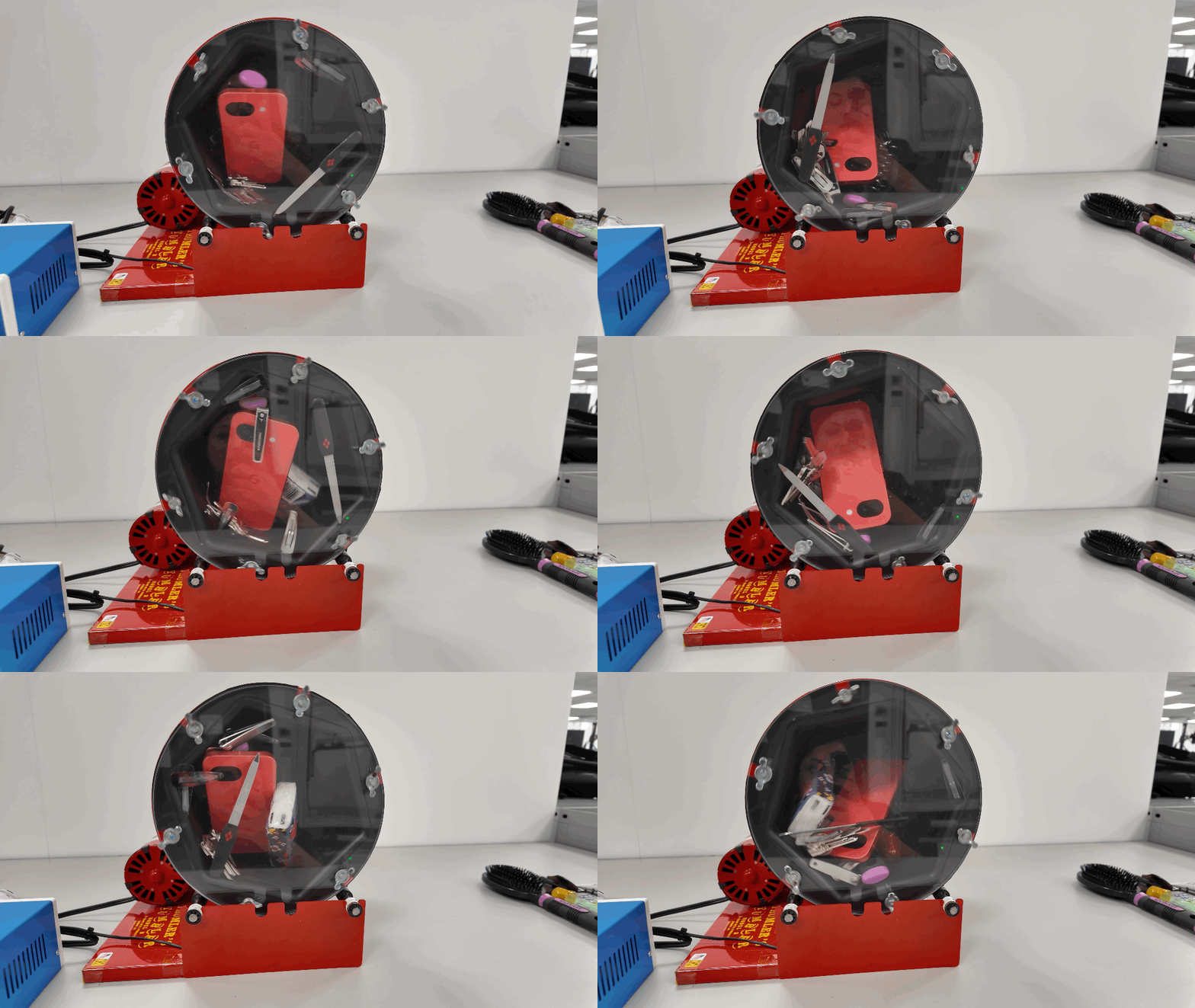
The phone still feels pretty much as comfortable and premium in the hand as its predecessor, thanks to its sturdy aluminum frame and “satin, silky” finish. It still has that clean, flat-back design, with the camera module now fully integrated into the rear panel.
Honestly, as I said before, the look and feel of the Pixel 10a are pretty much identical to the 9a, and it’s good to know the phone is sturdier this year. The new Berry colourway is also a personal favorite, and for me, more attractive than the Peony Pixel 9a.
Same Tensor G4, but with more AI trickle-down

The Pixel 10a runs on the same Tensor G4 and Titan M2 combo as the Pixel 9a. To me, that feels like a calculated move by Google in response to rising component and memory costs, which are expected to push smartphone prices higher this year. By sticking with an existing chipset, Google likely gave itself enough breathing room to keep the Pixel 10a at the same $499 price point. Still, not seeing the newer Tensor G5 here is a bit disappointing.
Don’t want to miss the best from Android Authority?
- Set us as a favorite source in Google Discover to never miss our latest exclusive reports, expert analysis, and much more.
- You can also set us as a preferred source in Google Search by clicking the button below.


That said, performance should feel very similar to the Pixel 9a in everyday use. I didn’t have enough time with the 10a during my hands-on to make any performance judgments, but based on our Pixel 9a review, the Tensor G4 should deliver a smooth UI, fast app launches, and reliable multitasking in typical day-to-day use. It did show occasional slowdowns under heavier workloads on the 9a, and it would be reasonable to expect similar behavior on the 10a.
Interestingly, even though the Pixel 10a runs on the older Tensor G4, Google is still leveraging the chip in meaningful ways. The phone brings over a few Pixel 10 AI features like Camera Coach and Auto Best Take, both of which Google had previously associated with the newer Tensor G5 processor.
Camera Coach is powered by Gemini models and offers real-time guidance on framing and composition. Meanwhile, Auto Best Take merges frames intelligently so everyone in a group shot looks their best with a single shutter press.
Even though the Pixel 10a runs on the older Tensor G4, Google is still leveraging the chip in meaningful ways.
The fact that these features are now available on a $499 device running the Tensor G4 suggests there’s no strict hardware barrier preventing similar features from coming to other recent Pixels, including the Pixel 9 series, via a future Pixel Drop.
It also raises the question of whether other Pixel 10 AI features, like Magic Cue, could eventually make their way to the Pixel 10a or older devices. Google has previously said that Magic Cue relies on the Tensor G5 and newer Gemini Nano models, but it’s unclear whether that’s a true hardware requirement or simply a strategic decision to differentiate flagship devices from the rest of the lineup.
Satellite SOS and connectivity improvements

While the Pixel 10a features the Tensor G4, a key difference this time is that Google has upgraded the modem. The Pixel 10a uses the Exynos 5400 modem, found in the flagship Pixel 10 and Pixel 10 Pro. That should technically improve cellular connectivity, download/upload speeds, and overall signal stability compared with the Pixel 9a, but again, we’ll have to test that more thoroughly when we review the phone.
Satellite SOS is a flagship-level safety feature now trickling down to $499.
What’s great is that the new modem also enables satellite connectivity on the Pixel 10a, which now supports Google’s satellite SOS feature for situations when you don’t have access to cellular or Wi-Fi. That’s a flagship-level safety feature now trickling down to $499, and it meaningfully improves the Pixel 10a’s value proposition, especially in markets like the US, where the feature is supported.
Quick Share meets AirDrop

Another notable addition to the Pixel 10a is Google’s new Quick Share-AirDrop compatibility, which was previously limited to the Pixel 10 flagships. Google has since confirmed that this cross-platform sharing support will roll out to more Android phones later this year, but having it available on the 10a from day one is something I’m extremely happy about.
The A series has long been popular among teenagers, a group that largely gravitates toward iPhones. If you’re picking up the Pixel 10a for your teen, they’ll likely appreciate the ability to transfer files more easily with compatible iPhones within Bluetooth range.
Battery and charging refinements

The Pixel 10a packs a 5,100 mAh battery, which Google says can last for over 30 hours in regular usage, and up to 120 hours with Extreme Battery Saver. We loved the Pixel 9a’s battery life, so having the same capacity is great. Sadly, charging isn’t getting the upgrade I was expecting.
I was really hoping for some Pixelsnap love here.
Although charging speeds are a bit faster at 30W wired and 10W wireless compared to the Pixel 9a’s 23W and 7.5W speeds, I was really hoping for some Pixelsnap love here, but Google hasn’t obliged. The current first-party Pixel 10a cases don’t have magnets, and the phone doesn’t support Qi2 charging as a trade-off made to maintain the lower price point
What’s not changing at all: Cameras

As I’ve said before, the Pixel 10a is a refined version of the Pixel 9a. Think of it like an interim update instead of a full-blown new product, and one of the most obvious, or perhaps pinching things that haven’t changed is the camera setup
There's no new hardware here, no larger sensor, no brighter aperture, no surprise telephoto addition.
The camera hardware is identical, featuring a 48MP main camera and a 13MP ultrawide camera at the back and a 13MP shooter upfront. There’s no new hardware here, no larger sensor, no brighter aperture, no surprise telephoto addition. And in 2026’s increasingly competitive under $500 camera phone market, that feels like a missed opportunity.
Don’t get me wrong, the Pixel 9a is a great camera phone, and with the same cameras, the 10a should not disappoint either. However, with devices like the Nothing Phone 3a Pro and other upcoming, aggressively spec’d mid-rangers offering more versatile camera systems at similar prices, Google clearly has its work cut out for it.
Where does the Pixel 10a stand in 2026?

On paper, the Pixel 10a doesn’t look dramatically different from the Pixel 9a. It has the same chip, same cameras, and a largely similar design, but Google is clearly betting on longevity and AI.
The Pixel 10a offers seven years of updates, a new modem for satellite connectivity, a sturdier build, trickled-down AI features, and other refinements, suggesting it’s not trying to win the spec war but instead aiming to win the experience war.
From my brief time with the phone, it feels like a careful, conservative upgrade. If you already own a Pixel 9a, which I do, I find there’s very little reason to upgrade to the 10a. But if you’re stepping into the Pixel ecosystem for the first time, or coming from an older A series device, the Pixel 10a still makes a compelling case.

Thank you for being part of our community. Read our Comment Policy before posting.