Affiliate links on Android Authority may earn us a commission. Learn more.

MCON is the first truly mobile controller that covers all of my gaming needs
MCON
MSRP: $149.99
What we like
What we don't like
MCON
It’s hard to believe that it’s been more than two years since the sliding magnetic controller that we now know as MCON was introduced to the world in a YouTube video. At the time, it was heavily focused on the Apple ecosystem, but now that the device is finally out, it’s turned into so much more.
Sure, it still has MagSafe magnets, but now so do Pixel phones. Magnets on phones are here to stay, and MCON is one of the first gaming controllers trying to take advantage of them with a sliding design that calls back to the legendary PSP Go and Xperia Play.
After testing it for a few weeks, I have to say it really delivers where it counts. Sure, the sliding part is fun and novel (again), but it’s also one of the most versatile controllers I’ve ever used.
A marvel of engineering

I’ve tested a lot of gaming devices, from controllers to dedicated gaming handhelds, and I have to say MCON is one of the most overengineered products I have ever seen. And I mean that in a good way.
Out of the box, it almost looks like a screen-less phone or wireless battery pack. Nothing about it screams “controller” if you don’t look too closely, and it slips very easily into a pocket or bag. I would never put a telescopic controller in my bag without some kind of case, but I have absolute confidence that the MCON can survive on its own in there. In fact, I’d almost be worried for the rest of the bag’s contents, because this thing is tough.
MCON has a rugged build, but a weak magnetic phone case can send your phone flying across the room.
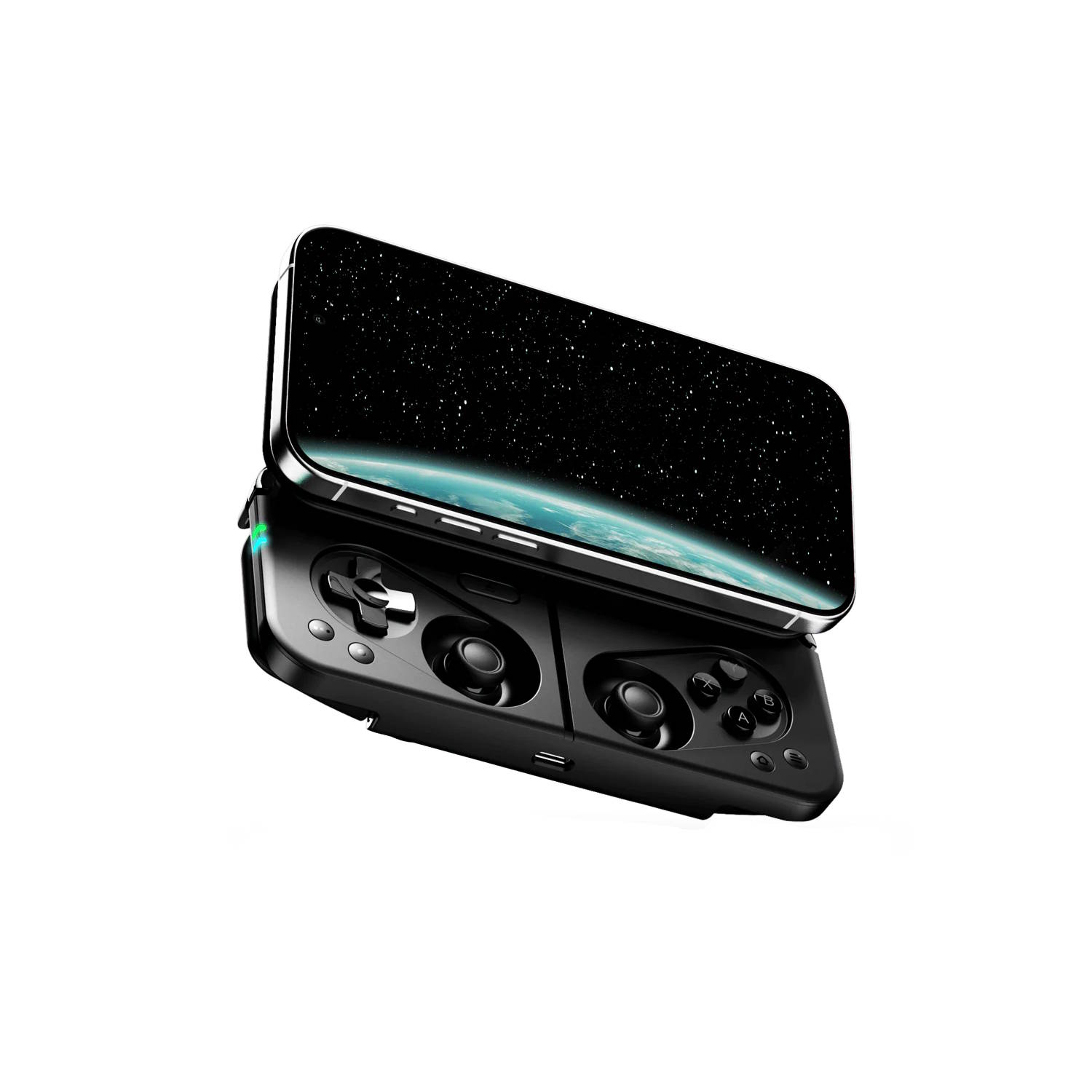
Functionally, it’s just a Bluetooth controller, but there’s so much going on behind the scenes. The device attaches to your phone with a magnetic puck. It’s fairly thick, so there’s no worry about it hitting or scratching even the fattest of camera bumps. The puck can also be slipped off and turned vertically, which is handy for Nintendo DS emulation and vertical games.
Then, there’s the headlining feature: the slider. There’s a big button on the top of the controller that is just begging to be pressed, and when you do, the controller absolutely flies out. It actually startled me the first time I opened it.
It has so much force that the first magnetic case I tried for my Pixel 9 didn’t cut it. There’s a magnetic array sticker in the box, but if you’re using a different magnetic case, make sure you pick one with the full magnetic array plus the line at the bottom (and not just the circle). Otherwise, you might unexpectedly shot put your phone onto the floor.

Before getting to the controls, I should also point out that the backplate can also detach from the controller and serve as a kickstand. This was actually one of the most comfortable ways to play on the MCON, although I wish the kickstand had more than one snapping point. Putting the whole thing back together is easy in a way that feels like magic, although I still feel like I’m going to break it every time I push them together. It’s not an interaction I’ve had with any other device, so it’s hard to get over the trepidation.
The sticks are heavily recessed, but have a great range of movement.
The controller itself is actually great. The dome switch D-pad doesn’t have much pivot, but I was still able to hit diagonals when I needed to. The buttons are also responsive and quiet, which is great for playing on the bus or next to my wife in bed.
The sticks are heavily recessed, but still have a nice range of movement. I initially found them pretty uncomfortable to use since they’re so close to the middle of the controller, but this was easily solved by flipping out the grips hiding in the back. That said, there’s a weird empty space in the back where the grips should go, and it’s noticeable when holding the controller. For D-pad-centric games, I found it better to keep the grips stowed. They’re also very stiff to remove, with no place to get leverage.

But my only real complaint about the MCON’s inputs are the shoulder buttons and triggers. The shoulder buttons are absolutely tiny. I found them both too thin and too short, which is further complicated by the fact that the whole setup is quite top-heavy. My index fingers had to both hold the phone up and scrunch up to hit the shoulder buttons, which is a lot to ask from my aging dad gamer hands. The analog triggers are also small, but at least they’re slightly bigger and further from the back of my phone.
All things considered, I was able to make progress in challenging games like Dead Cells or Silksong (via GameHub), which is how I typically put these controllers through the gauntlet. It’s not quite as comfortable as a large telescopic controller, but it’s so portable that it’s not even in the same category.
Game on

When testing MCON over the past few weeks, I found that there are certain scenarios where it’s great, and others where I’d rather reach for something else. The most obvious win is playing controller-compatible mobile games. I gave up playing heavy games like Genshin Impact or Destiny: Rising with touch controls, but with two sticks on the go, I’m back in the game.
The other great use case for me was game streaming. Paired with Xbox Cloud Gaming, it can turn your phone into a fantastic little gaming device. Having a full range of inputs is absolutely transformative, whether attached to your phone or playing in tabletop mode. The same is true for local game streaming via Steam Link, Moonlight, or Razer Nexus.
MCON is a little too big to take with me everywhere, but it's perfect for longer trips.
It’s also great for emulating games on my phone, which I had previously abandoned in favor of dedicated gaming handhelds. I can’t say that I would always take MCON with me in my go bag, since it’s roughly the size of a small gaming handheld, but I would take it on a flight or longer trip. For whatever reason, I feel less embarrassed pulling out this sliding controller than a gaming handheld in front of strangers on a train.
That said, when not on a train or in front of the judgmental public, I still prefer dedicated gaming handhelds. There are just so many great options out there, and most of them are actually cheaper than MCON. For example, the ANBERNIC RG Slide, which has a similar Xperia Play-style sliding mechanism, retails for the same amount but can frequently be found on sale for much less. It’s probably not as powerful as your phone, but the fact that it isn’t a phone makes it a more suitable dedicated gaming device for me.

Earlier, I also mentioned that the magnetic puck can be turned to play vertically, but in practice, I didn’t find this very useful. Nintendo DS games played fine, but the weight balance was terrible. Many DS games also require touch inputs, and taking one hand off the controller to tap the screen made things worse. At that point, I’d rather just play with touch controls (or a purpose-built handheld like the ANBERNIC RG DS).
But aside from edge cases like Nintendo DS emulation, MCON is a solid option for any time of gaming I do on my phone. Unlike gaming handhelds, my phone is always with me, and MCON is a much easier travel companion than a telescopic controller. Those two factors make the setup incredibly versatile, and I could easily see this becoming my preferred way to play most games I used to play with touchscreen controls.
MCON review verdict: Should you buy it?

There’s one thing that I haven’t touched on yet, and it’s the biggest downside to the entire device. MCON retails for $150, which is a very hefty fee to pay for a Bluetooth controller, regardless of how fancy it is or the level of engineering that went into its design.
Still, if you’re someone who already plays a lot of games on your phone, it could very well be worth the price of entry. Not everyone wants to buy a whole separate device just to play games on Android. MCON and controllers like it help bridge the gap.
MCON is the most versatile mobile controller you can buy.
In terms of alternatives, there’s really only one other similar magnetic controller on the market, and that’s the Abxylute M4. It’s still in the crowdfunding stage, but it’s much cheaper and more compact. It’s actually the controller I currently keep in my bag, with the huge caveat that I only use it for D-pad-centric retro games. The sticks on the M4 don’t hold a candle to those on the MCON, nor do the ergonomics as a whole.
For better ergonomics, you’ll have to turn to telescopic controllers. The Backbone One ($99.99 at Amazon) and Backbone Pro ($169.99 at Manufacturer site) are some of the most premium options, and they both offer a great gaming experience. Cheaper options like the GameSir G8 Plus ($79.99 at Amazon) or Abxylute S9 will also get the job done. The tradeoff is that they are much less portable, and you lose the neat kickstand mode for tabletop play.
At the end of the day, nothing can do what MCON can do, which is a testament to just how versatile this design is. In a controller market that’s absolutely saturated with nearly identical products, it stands out and manages to make gaming on my phone actually fun again. It took more than two years (and the help of Oh Snap) to get through the finish line, but hopefully this is just the start of a wonderful new line of magnetic controllers.
- Highly portable
- Great build quality
- Nice inputs
- Very versatile
- Heavy
- Small shoulders and triggers
- Expensive
Thank you for being part of our community. Read our Comment Policy before posting.