Affiliate links on Android Authority may earn us a commission. Learn more.
I gamed on 2026's best Snapdragon and Exynos flagship phones — and the benchmarks lied
Jun 22, 2026 — 5:00 AM ET


One thing I’ve wanted to find out since the launch of the Galaxy S26 series is just how well Samsung’s new Exynos 2600 chip and its Xclipse 960 GPU stack up when playing the latest Android games. The brand is clearly positioning it as a top-tier gaming platform, especially with its dual-chip strategy for non-Ultra flagships — some customers receive Exynos variants, while the US and select markets use the Snapdragon 8 Elite Gen 5 for Galaxy — but can it really compete with Qualcomm’s fastest chip in the business?
Samsung’s overclocked ‘for Galaxy’ Snapdragon proved to be a marginal benchmark topper, leaving the Exynos 2600 with a lot of work to do if Samsung wants to offer comparable performance and gaming experience across its entire lineup. To see exactly where Samsung’s new Exynos flagships stack up, I grabbed my Snapdragon-powered Xiaomi 17 Ultra, OPPO Find X9 Pro with a MediaTek Dimensity 9500 onboard, and Google’s Tensor G5-equipped Pixel 10 Pro XL.

A quick look at benchmarks suggests the Exynos chip may trail the top Snapdragon and MediaTek competitors in peak performance, but should still outperform Tensor-based hardware. However, real-world gaming performance often tells a different story.
Exynos Galaxy S26 gameplay performance test

The first game in my usual rotation is Genshin Impact. The open world, with all options set to the maximum available configuration and the frame rate set to 60fps, was once a significant stress test for high-end phones. However, most of today’s flagship handsets handle this setup with a tightly locked frame rate, and the Exynos-equipped Galaxy S26 Plus is no exception.
However, Google’s Pixel 10 Pro XL and its Tensor G5 chip struggle more noticeably. Its Imagination Technologies PowerVR DXT-48-1536 GPU just can’t keep up with the fastest Adreno, Mali, or Xclipse graphics units found in comparably priced flagship phones, with gameplay barely hitting 45fps on average.
To further differentiate performance, I turned to a high-refresh-rate title: Call of Duty Mobile. The game’s Battle Royale mode combines open-world geometry with a maximum 120fps cap and fast-paced, demanding action, making for a heavy workload. However, in this test scenario, Samsung’s Exynos flagship is capped at 60fps, with no way to unlock the ultra setting, even when graphics are turned down, despite being several months post-launch.

Performance still feels smooth, but for competitive, first-person gameplay, you can actually achieve a higher frame rate on Google’s comparatively low-end Tensor G5, which holds closer to 80fps. That’s not a huge difference in smoothness, but it shows that GPU driver identification and chipset configuration lists can have a significant impact on the graphical and performance experiences available.
Based on the Genshin Impact results, I would expect the Exynos chip to easily pull in a steady 90fps in this test, and it’s entirely possible it could reach close to, if not lock, 120fps as well.
Per game GPU/handset optimizations can leave performance on the table.
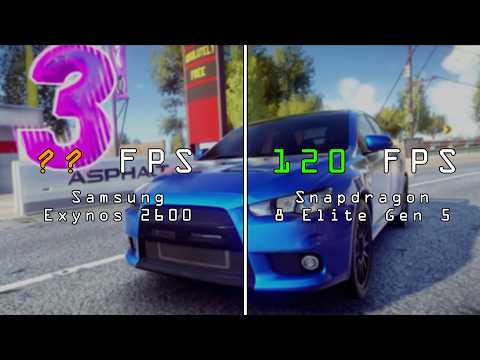
I eventually found a game that lets the Samsung Galaxy S26 Plus run at 120fps: Asphalt Legends. This time around, the OPPO Find X9 Pro doesn’t allow for a full 120fps unlock, while the Pixel 10 Pro XL really struggles with the game’s highest graphics settings.

The results are much more comparable to the Snapdragon 8 Elite Gen 5, delivering very close to 120fps throughout. However, the result isn’t exactly smooth (see below), hovering between 100 and 120fps. The 8 Elite Gen 5 is smoother in-game, locking at 120fps. The dips down to 80fps are a different issue I’ve seen in other titles, which seems to be a power-scheduling issue on Xiaomi’s part.
However, I noticed the Galaxy S26 Plus became rather warm after just a single race in Asphalt Legends, while the other phones all remained reasonably cool. I continue the test for longer to investigate what would happen to the phone’s performance, and the results aren’t great.

With high-end graphics settings and a high target frame rate, the Exynos 2600 warms up rather quickly. While peak performance was sustained for a couple of minutes, the phone soon pulled back quite substantially, with frame rates falling from around 113fps to closer to 80fps over about 10 minutes (or four races).
This behavior is not unique to Exynos-based devices; all modern mobile flagship chips reduce performance under thermal load. However, the degree and timing of throttling vary significantly across devices, cooling systems, and firmware tuning, and Exynos seems to heat up more quickly than others. This is definitely something to consider if you want a gaming phone to keep you entertained on a long daily commute.
Should gamers buy an Exynos phone?

Playing a small selection of games on the latest Android flagships has left us with quite a few things to mull over. One of the major sticking points through this test has been the impact that per-game optimizations and configurations have on the gameplay experiences available, regardless of how much theoretical graphics grunt your phone has.
Despite being very capable, the Exynos 2600 and Dimensity 9500 were capped at 60fps in at least one title, where they could have performed even better. Snapdragon was not. 60fps is smooth, of course, but when you’re paying for top-tier performance, you want to at least have the option to go full pelt when you want. This occasionally plays into Pixel’s hands, which, while clearly inferior in benchmarks, can often fall much closer to the artificially limited performance of other chips.
Pinning the blame here is difficult. On the one hand, game manufacturers tweak their settings to ensure that consumers aren’t disappointed by cranking the settings up too high, but this then puts an additional burden on game developers and vendors to keep their lists up to date.
Exynos isn't a bad performer, but a few issues keep Snapdragon a firm gamer's favorite.
On that thread, the Exynos 2600 has a thermal ceiling that’s easier to hit than rival flagship chips when performance and graphics settings are cranked to the max, as our Asphalt Legend result shows. When gaming at moderate settings and lower frame rates, the chip is every bit as good as its benchmark-topping Snapdragon and Dimensity rivals. However, these two can run cooler for longer while pushing out more frames at the same time. On that metric alone, they’re the better GPUs.
The Samsung Galaxy S26 and S26 Plus, powered by the Exynos 2600, are capable mobile gaming platforms, with some caveats. Snapdragon- and MediaTek-based alternatives offer more consistent peak performance and lower thermals in real games, while Google’s Tensor-based devices tend to lag behind in most, but certainly not all, gaming scenarios.
For Samsung fans prioritizing high-end mobile gaming, the exclusively-Snapdragon Galaxy S26 Ultra is still likely the best option.
Snapdragon 8 Elite Gen 5 for Galaxy
Power AI features
Thank you for being part of our community. Read our Comment Policy before posting.