Affiliate links on Android Authority may earn us a commission. Learn more.
I used the Motorola Edge (2026) all summer long, but it never won me over
Sep 17, 2026 — 7:14 AM ET



I’m one of the bigger Motorola fans at Android Authority. If nothing else, I’ve spent the most time with a Moto phone in my pocket, ranging from several generations of the dirt-cheap Moto G to the recent heights of the ultra-premium (and Ultra-branded) Motorola Razr Ultra. There’s just something about the clean Android experience and fun Pantone colors that has always spoken to me; what can I say?
In that time, though, I’ve watched Motorola’s Edge series go through the wringer. I remember when it first rolled out as a flagship, only to become an affordable flagship-style option a year or two later, and before finally settling as a sub-$600 mid-ranger. And yet, there was still plenty to like about the Edge, even at its cheaper price point.
Now, I’m not so sure. I’ve spent months with the Motorola Edge (2026), and I can’t help but question almost everything about it. Buckle up, it’s going to be a bumpy ride.
I’ll admit, it’s a good-looking phone

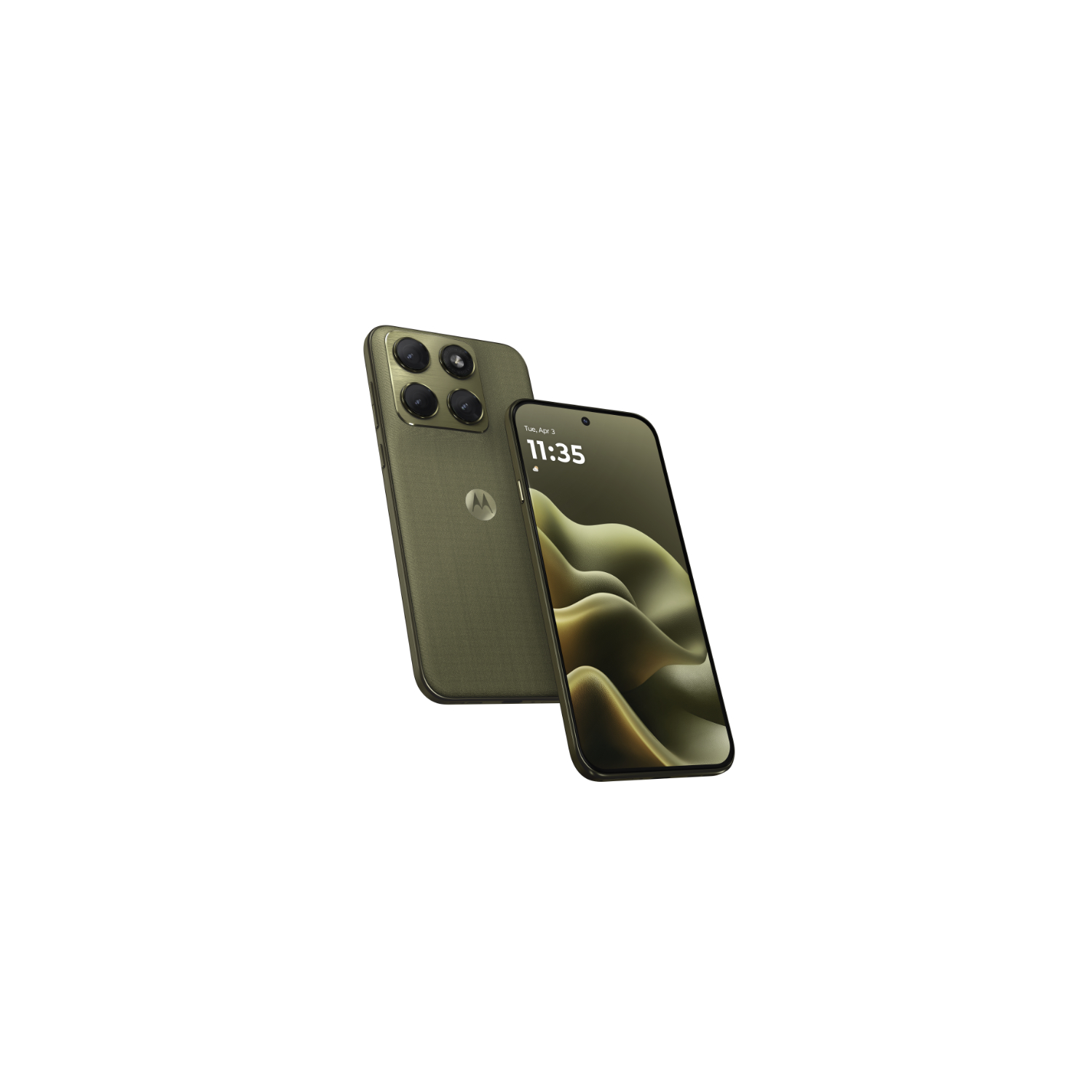
Before I go poking holes in Motorola’s balloon, I have to say I like everything about the design of the Edge (2026). It’s clean, simple, and fits comfortably in my hand — something that still doesn’t happen very often, even though smaller displays have become more popular. And honestly, I think the design does a lot of heavy lifting when it comes to keeping the Motorola Edge (2026) in my pocket. If it didn’t look so good or fit so nicely, I’d have ditched it by now.
What, exactly, looks so good? Motorola and Pantone have once again nailed their color choices. The Martini Olive finish I received feels premium, pairing a woven back panel with a slightly rounded frame that’s brushed to look like metal. It’s not — the frame is plastic — but it certainly fooled me the first time I picked up the Edge (2026), and it still feels good after all this time. In fact, it still feels enough like metal to keep fooling me. The brushed gold-like texture carries over to the camera bump, which is big, square, and unmistakably Motorola.
The overall look is almost (and I do mean almost) as good as Motorola’s other Martini Olive option, the Motorola Signature. That phone actually has an aluminum frame and tougher display glass, and it feels stunning in the hand. Too bad it’ll never come stateside — a move that I think is a mistake when the Edge (2026) is so decidedly mid-range.
Anyway, my appreciation of the Edge (2026) isn’t purely aesthetic. Its compact size represents a massive (get it?) departure from its predecessors. The Edge still isn’t smaller than a closed Razr (2026), but it’s smaller than any traditional Moto. I’d describe the Edge (2026) as a complete 180-degree flip from the Edge (2025), which centered around a huge 6.7-inch pOLED panel. This version shrinks to a 6.3-inch Extreme AMOLED, and I actually feel like I can reach all three buttons without doing hand gymnastics.
I no longer feel like I’m straining to power the phone on, bump the volume up or down, or press the Moto AI key — at least, that’s how I’d feel if I ever used hardware-based AI triggers. Unfortunately, you can’t program the AI Key away from Moto AI either; you can only toggle it on or off. Honestly, I wish Motorola had copied Apple’s Action Button; I’d love to set it up as a volume toggle or a camera trigger.
Motorola, please, let me reprogram the Moto AI Key.
Also, while I like the Martini Olive color that Motorola and Pantone settled on, I’m a little surprised it’s the only color option. I like fun phones, but I know plenty of people who would much rather have a black, gray, or white slab to pull out of their pocket — especially if they’re just going to put it in a case anyway. The woven texture probably won’t be for everyone, either, as it doesn’t really add any grip.
What will be for everyone is that you could get away without putting the Edge (2026) in a case if you didn’t want to. It’s a tough cookie, pairing IP68 and IP69 ratings with MIL-STD 810H drop protection. I’m still disappointed by the use of plastic pretty much everywhere, and the Gorilla Glass 7i display is good, more than great, but it was reassuring to take this phone for a few days at the beach without a second thought.
The 6.3-inch AMOLED panel also ensured I could use the Edge (2026) at a bright, sunny beach, and not just because it was easier to block the glare given the smaller footprint. For whatever reason, Motorola decided to pump its pocket-sized mid-ranger with 5,200 nits of peak brightness, which is more than enough. You’ll rarely hit that full brightness, but the Edge (2026) is plenty visible even at three-quarter strength.

I was also impressed by the Super HD (2,640 x 1,216) resolution, which was plenty sharp for streaming World Cup games when I couldn’t make it to a watch party. I turned to the Edge (2026) for a handful of group stage games and never felt like I was missing the action despite the tiny display. The dual Dolby Atmos speakers carried their weight, too, though I preferred them for streaming Spotify rather than suffering through soccer analysis from Alexi Lalas. Either way, they got loud and punchy without feeling mushy, which worked for me.
All told, if I were buying the Motorola Edge (2026) purely for its design, I’d be first in line. I’d pick it up, put my SIM in it, and keep it there for as long as I can. The problem, however, is that I’d actually have to use the Edge (2026), which is a less enticing proposition.
No edge under the hood

When I first looked at the spec sheet for the Motorola Edge (2026), I thought to myself, “This is fine.” I wasn’t blown away, but I picked out the MediaTek Dimensity 7450 as an expected annual upgrade and noted the 60W TurboPower charging should be pretty quick. Then I refreshed myself on the previous Motorola Edge (2025) and realized the new version isn’t as much of an upgrade as it seems.
For starters, the newer chipset is the only real upgrade. The 8GB of base RAM stayed the same, only this time it’s paired with 128GB of base storage instead of 256GB — an odd choice when there’s no slot for a microSD card. The 5,000mAh battery is also smaller than before — the 2025 version packed 5,200mAh — but I’ll let that slide because the phone is so much smaller. More annoying is the fact that the 60W TurboPower charging is actually a downgrade from the previous 68W.
But before I convince you that problems on paper equate to problems in real life, let’s look at some benchmarks. I put the Edge (2026) through our usual gauntlet, hoping that its CPU and GPU would surprise me, and here’s what I got in return.
For those of you keeping track at home, this isn’t golf. Lower numbers aren’t good. The Motorola Edge (2026)’s performance is not good. I did my best to compare it to phones of fairly similar prices, from the Google Pixel 10a at $499 to the Samsung Galaxy S25 FE at $649 and the OnePlus 15R at $699, and I didn’t expect it to beat them all. I just didn’t expect it to get dunked on, either.
Its 4nm Dimensity 7450 got beaten over and over again by everything from Samsung’s 4nm Exynos 2400 to Google’s 4nm Tensor G4, showing that process alone wasn’t Motorola’s problem. There’s just not much power for the Edge (2026) to work with. The results don’t improve on the gaming side, either, with the Edge (2026) holding it down in the basement of our stress test. No, I guess the phone doesn’t lose steam towards the end of its run — the scores don’t tail off — but the Edge (2026) never scored more than half of the Pixel 10a’s worst run, either.
There's no reason a $600 phone should come up short in this many benchmarks.
As a Motorola fan, that hurt to write. It would hurt less if the Edge (2026) somehow pulled off some magic in day-to-day life, but you can guess what’s coming.
There’s just nothing about using this mid-ranger that’s as sharp as its name (or design) would suggest. It has the punch and cutting power of a butter knife, but only if you let the butter soften a bit first. I encountered struggles no matter what I asked of the Edge (2026). Pokémon Go took painfully long to load and run, and simple tasks like navigating my way through East Rutherford, New Jersey, to watch a World Cup match slowed the Edge to a crawl.
Worse, the Edge (2026) runs hot. I don’t mean a little warm, either; the Edge sometimes felt like it had an old Tensor chip inside. I had to tuck it back into my pocket on a long photo walk, and I finished my stress testing with the phone sitting flat on my desk so I only had to tap the display with my fingertips.
I have plenty of questions about the current state of Hello UX, too. It’s not long ago that Motorola’s most annoying quirks (its bloatware) were reserved for its Moto G series. I knew to expect the terrible, ad-laden 1Weather app and a gaming folder that was really just a shortcut to the Play Store in disguise. Now, they’re on the Edge (2026), too. You also get Chime for banking, Perplexity, and Copilot right out of the box. I’m all for having a favorite AI agent, but to throw Moto AI in there and make me balance three of them feels a bit much.
I’ve also harped on Motorola more than once about its weak update commitment, and I’m disappointed to report that it’s no better here. Yes, two years of Android support and three years of security patches is better than what the Moto G series gets, but it’s far behind the seven years many of Motorola’s similarly priced rivals offer. And, when some of those rivals are cheaper and deliver better benchmarks than the Edge (2026), it becomes much easier for me to steer you in another direction.
I’m willing to give the Edge (2026) one more chance, though, because I still have to walk you through its battery life. The phone still packs a 5,000mAh cell, and it’s backed by 60W TurboPower wired charging, and that has to be worth something. So, here are the benchmarks you’ve been waiting for.
In this case, I’ll call the Edge (2026) respectable. It ties the iPhone 16e in most categories, and at least comes within striking distance of the Pixel 10a a few times. Motorola’s 5,000mAh cell only comes out as the outright winner in terms of camera performance, but at least that’s one test it can be proud of. Unfortunately, the Edge (2026) has a battery nearly 1,000mAh larger than the iPhone 16e, so these marginal wins aren’t actually that impressive.
On the charging side, the Motorola Edge (2026) is much more impressive. Its 60W TurboPower charging gets the 5,000mAh cell back on its feet in under an hour, beating the OnePlus 15R by almost 10 minutes. Motorola finally gets its chance to run circles around the Pixel 10a, too, beating Google’s mid-ranger by almost half an hour. You’ll need a compatible USB PD PPS charger to reach those top speeds (Motorola’s 68W block is probably your best bet), or you can charge 15W wirelessly if you don’t mind a much longer wait.
Not the sharpest of summer memories

Despite the underwhelming performance, I wanted to hold out hope that Motorola’s cameras could bring me back into the fold. After all, its color science has always been pretty natural, and the close relationship with Google has given Motorola plenty of helpful photo-editing tools to get close to the best camera phones. But with a trio of camera sensors that carry over a lot from its predecessor, I knew I’d have to test the Edge (2026) before giving it a passing grade.
Sure, its 50MP primary sensor would be capable, but that’s never been Motorola’s struggle. The stacked LYTIA 710 sensor (an update from the previous LYTIA 700) enables better light capture with its deeper pixels, boosting the Edge’s low-light performance. The wide maximum aperture of ƒ/1.8 does the same, backed by OIS for decently steady shots. Motorola’s 50MP ultrawide sensor doubles as its macro camera with a maximum aperture of ƒ/2.0, and the 10MP telephoto sensor adds 3x optical zoom and maxes out at 30x Super Zoom. So, with that quick rundown, let’s get to some camera samples.
Of this first row, how can you not pick out the two beach chairs on the far right as a favorite? It’s one of the last images I captured with the Edge (2026), and I like everything about it. The colors are spot on, the detail is good, and there’s just a little bit of natural falloff with the fence posts in the background. It probably helps that I prefer to capture images at 2x zoom, as I find the field of view much more comfortable for most scenes.
I’m also pretty pleased with the image in the center, which shows off what the 10MP telephoto sensor can do. It recreated the colors of both the water tower and the sky nicely, and I’m relieved the Edge (2026) didn’t try to bring the leaves in the foreground into focus — an issue I encountered with another composition I tried earlier in the day.
Although this row continues the excellent color recreation, it begins to show some of the Edge’s weaknesses. The soccer player’s face is a bit simplified off to the left, and the leaves surrounding the steeple are muddied in the darker areas. I do really like the photo I captured of Audi Field when leaving after a match, as I think the Edge (2026) nailed the lighting on the support columns and the underside of the bleachers.
If you’ve read any of my previous reviews, you’ll know that the ultrawide camera is rarely my favorite, and that rings true here too. I used it plenty, trying to fit the entirety of Audi Field’s west stand into one shot, but the distortion of the fans in front is impossible to ignore. The colors are good, though, and the image of the lifeguard station does a better job of maximizing its field of view without bending the foreground too much.
I’ll toss in a few macro samples as well, as I’m so glad Motorola didn’t try to sneak dedicated hardware in on us. The 50MP ultrawide sensor is actually at its sharpest when close-up, with really sharp details in the wood carving and the metal lighthouse. I can’t believe I’m saying this, but the camera works better as a macro sensor than an ultrawide camera.
I can appreciate when a phone camera gives its portrait mode measurements in millimeter equivalents, so the Edge (2026) was right up my alley. It’s so much easier to jump between focal lengths when you can picture the camera lens in your mind, and I spent almost all of my time between the nifty 50mm and the everyday 35mm portrait modes. The artificial bokeh gets a little tighter each time you zoom in, which mimics a mirrorless camera nicely, though the depth of field at 24mm is maybe a little deeper than I would like. I know it’s a wide portrait, but I’d prefer a softer background straight out of camera.
Stop me if you’ve heard this before, but the Motorola Edge (2026) is strongest when using its primary camera. Unfortunately, that doesn’t cover much of the zoom range. The 1x zoom sample above is probably the sharpest of the bunch, followed closely by the 2x crop next to it, but then megapixels become harder to find. As soon as you hit 3x zoom, you have to rely on the smaller telephoto sensor, which is still decent given the far-off subjects, but there’s a noticeable shift in the color profile.
At 6x zoom, the sand in the foreground looks a little crushed — which is funny because it’s sand — but the details in the lifeguard chair itself aren’t too bad. I think 6x zoom is about the limit of what I’d post on social media, though, because the next three samples give up the details pretty quickly.
Motorola wants to call its long-range zoom Super Zoom, but I have to say there’s not much super about it. The 10x shot is okay, at least if you focus on the orange towel and blue chair in the foreground, but the text on the lifeguard jackets looks muddy, and the child in the far background is hard to make out. The text only looks more AI-generated as you zoom in further, while the towel looks flatter, the ocean looks blurrier, and the beach itself looks more like mud.
At 30x zoom, when you’re relying heavily on a small 10MP sensor, you’d be forgiven for thinking the left jacket said “S88P” and the right jacket had a smear of bird poop on it. In reality, that reads “SHBP” and the flash of color is the American flag. Not great, definitely not super.
The Edge (2026)’s 50MP selfie camera might be over the top — I don’t need that many megapixels for my face — but I can’t argue with the outcome. I like the detail in both selfies, and the portrait detection around my head is pretty good down to the smallest of hairs. Not much to complain about, just not sure we need megapixels for the sake of megapixels.
Finally, there’s video. The Edge (2026) tops out with 4K resolution at 30fps, which is sub-part for this price point — above $500 typically gets you 4K at 60fps. I felt like it was fine for capturing the Norwegian supporters’ section doing its famous row at the World Cup, pairing decent sound with pretty good stabilization so I could show the experience off to my friends, but if you want to capture in 4K quality, you’ll be sacrificing on the smoothness of the footage.
If you want to check out full-resolution versions of these samples (and many more), you can do so at this Google Drive link.
Motorola Edge (2026) review verdict: Should you buy it?

I couldn’t tell you the last time I used a review device for quite this long. It’s almost impossible to do so when the phone launch calendar is what it is, especially as fall rolls around. And to make my decision even more surprising, this is a phone I’ve used for months and find very hard to recommend at MSRP.
Normally, if I use something for this long, it’s because I love it. I usually have to make excuses to spend more time with it, or maybe move a different SIM into it just to keep service for a little longer. This time, I stuck with the Edge (2026) because I hoped it would turn a corner. I hoped it was just an update or two away from competing in a crowded mid-range market, and that its slim form factor would become a highlight instead of its only hope. That didn’t happen.
There are a lot of good mid-range phones in 2026, but the 2026 Motorola Edge isn't one of them.
Although Motorola’s design is as good now as it was when I first fired up the Edge (2026), that’s almost the only thing I can praise. Sure, its wired charging is good (it’s really good), but it’s technically a downgrade from last year. I took the Edge (2026) to soccer games both eight rows from the field and 80 rows from the field, and its cameras didn’t keep up with either match. Its Dimensity 7450 chipset tried to burn a hole in my pocket, and it did so without ever outpacing its competition. Mix in Motorola’s bad software habits making their way to a higher price point without any extra years of support, and I’m just kind of bummed.
This doesn’t feel like a phone from the same company that just launched the superb Razr Ultra (2026) and Razr Fold. It feels like a box that’s checked because it has to be, not because anyone should spend $600 on it. And keep in mind that’s $50 more than the price of the Motorola Edge (2025), too. Yes, all phones are getting more expensive this year, but very few are making such severe cutbacks while also raising prices.
So, if you’re looking for somewhere else to spend your mid-range money, you’re in luck. The Google Pixel 10a ($499 at Amazon) is downright excellent, and it’s even cheaper than the Edge (2026). While it comes with a slightly older Tensor G4 chip, it’s still powerful enough to pass Motorola in almost every benchmark, and it does so with plenty of Gemini features onboard. Granted, the Pixel 10a only packs two cameras on the back, so you’ll lose a little zoom range, but you might find better zoom quality along the way.
Samsung’s Galaxy S26 FE ($799.99 at Samsung) is yet another pick that’s more worthwhile than the Edge (2026), though slightly more expensive. I haven’t used the new model just yet, but it should bring slight improvements over the Galaxy S25 FE, which was very good with well-rounded cameras, several years of software updates, and solid battery life. Samsung’s build quality typically tops Motorola’s too, so you’ll get tougher materials for your money.
If you want to venture further outside the main mid-range Android market, I’d also suggest either the Nothing Phone 4a Pro ($499.99 at Amazon) or the iPhone 17e ($599 at Amazon). The former is the most expensive of Nothing’s budget offerings, swapping the semi-transparent industrial design for a metal body with an industrial camera bump and pairing it with a big, round Glyph Matrix. I love Nothing’s black-and-white software, which brings cleanliness to everywhere that Motorola has started to bring clutter.
The latter is your best (only) option for a cheap iPhone. It offers the power of an A19 chip, but anchors it with a thick Face ID notch, a single rear camera, and a 60Hz refresh rate. But hey, it’ll get years and years of updates, which is more than Motorola is willing to offer.
- Excellent compact, comfortable design
- Bright, sharp AMOLED display
- Strong IP68/IP69 durability
- Fast 60W wired charging (even if a downgrade)
- Good primary camera
- Poor performance for the price
- Runs excessively hot
- Weak software update commitment
- Storage downgraded to 128GB
- Inconsistent camera system and weak long-range zoom
- Bloatware-heavy software experience
Thank you for being part of our community. Read our Comment Policy before posting.