Affiliate links on Android Authority may earn us a commission. Learn more.
I'm a pro photographer and these are my favorite gimbals for iPhone or Android in 2026
Smartphones have their own methods for stabilizing video: OIS and EIS. While these technologies have improved significantly in recent years and there are plenty of great camera phones, nothing quite beats the performance that actual smartphone gimbals offer. Shaky hands, sudden movements, jumps, and trips will still significantly show up if you hand-hold your smartphone while recording.
Are you looking for the best smartphone gimbals? You’ve come to the best place. As a pro photographer and writer here at Android Authority, I’ve tested plenty of them and have studied nearly all of them. Let’s go over my favorite options you can get for different types of users.
DJI Osmo Mobile 7P: The best smartphone gimbal overall

- Can use any camera app
- All features of prior model
- Big battery
- Lower price
- Better for iPhone than Android
- Still pretty expensive for a gimbal
DJI often finds itself at the top of the smartphone gimbal food chain; its latest and greatest isn’t the exception. The DJI Osmo Mobile 7P is a true successor to the Osmo Mobile 6. There’s also the Osmo Mobile 7, but in some ways, we saw that as a bit of a downgrade. The DJI Osmo Mobile 7P makes no sacrifices, and it is the best smartphone gimbal we have tested.
There are multiple factors to consider when picking the right smartphone gimbal, and the DJI Osmo Mobile does a great job of checking most of the boxes. The most exciting part is the multifunction module. This magnetic accessory attaches to the gimbal, and honestly, it almost feels like it has superpowers.
This module takes care of most of the smart and connectivity functions. Powered by AI, it is the brain behind Active Track. This module can identify people and track them, making the gimbal automatically follow a person or item. This means you can use tracking without even using the Mimo app, giving you the ability to choose the camera app of your preference. In fact, you can control it using hand gestures, so you don’t even need to touch anything. Additionally, it has a fill light, and it can work as a transmitter for the DJI Mic Mini!
The DJI Osmo Mobile 7P can use AI to track the subject without using the Mimo app. You can use any camera app!
We also loved that the battery life was improved, as the Osmo Mobile 7P comes with a larger 3,350mAh battery. Additionally, the design has been significantly improved. The unit is easier to fold, and you don’t need to remove the smartphone clamp to do so. The tripod is built right into the unit, instead of being a separate screw-in accessory. It also has a built-in selfie stick extension!
Features are plentiful. Aside from the AI capabilities, you can use the Mimo app to shoot in all types of modes. These include timelapse, hyperlapse, panorama, story mode, dyna zoom, shot guides, and more. Get this: You can even control it with your Apple Watch! Sadly, Wear OS users don’t get the same benefit yet, and we don’t know if it will ever come to Google’s smartwatches. That is about the only thing we can complain about, though. Otherwise, the DJI Osmo Mobile 7P is the best smartphone gimbal around.

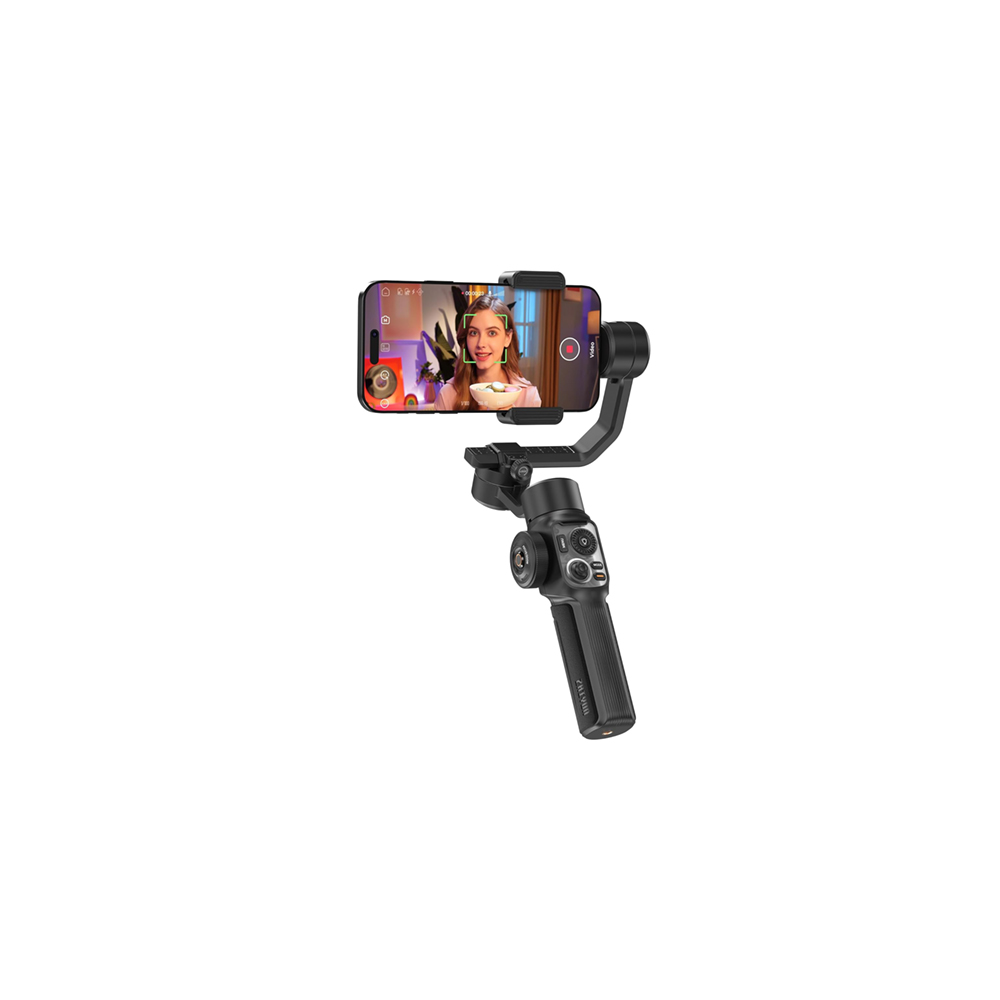
Zhiyun Smooth 5S AI: The best smartphone gimbal runner-up
- 3-axis stabilization
- AI tracking
- Great design
- Portable and compact
- Pricey
The DJI Osmo Mobile 7P gets some brownie points for its portability, compatibility with the Mic Mini, and a few other factors, but it isn’t the only brand offering AI-powered, high-tech smartphone gimbals. Zhiyun comes very close to it. In fact, some of you may like it more, even if it is a bit more expensive at $169. And that’s the base price, which doesn’t include the AI tracker or extra fill lights. You’ll have to pay more to get those! (Up to $249 for the Pro model, which comes with both).
Let’s start with the main downside. The Zhiyun Smooth 5S AI is not as portable. It is significantly larger than the DJI’s top dog at 311 x 168 x 52mm when folded, compared to 190 x 95 x 46mm. That said, many would argue that the build quality is significantly better (including myself). It has more physical buttons, too, and the side wheel is considerably bigger, giving you a more comfortable grip.
If you don’t mind carrying around a bigger gimbal, you’ll be rewarded with more comfort and controls. Another reason why this is not exactly our favorite is that the module functionality isn’t multi-functional. In this case, the AI module only does the tracking. It’s not multi-functional. A separate fill light can be attached to the bottom, and a second fill light is built into the gimbal’s arm. The cool thing is that you can actually use two magnetic fill lights if you don’t need the AI tracker, so you get a bit more flexibility.
The Zhiyun Smooth 5S AI is a better option for those who take their mobile film-making a bit more seriously.
Otherwise, the functions are the same. You can control AI tracking using gestures, as well as tapping. You can also use any camera app with it, and don’t need to stick to Zhiyun’s ZY Cami app.
Overall, the Zhiyun Smooth 5S AI might be a better option for those who take their mobile filmmaking a bit more seriously. The controls are much more advanced, the build is nicer, and the magnetic connections give you more flexibility to play with fill lights. It just sacrifices portability and costs more.

Insta360 Flow 2 Pro: The best ultra-portable smartphone gimbal
- Very portable
- AI module can track using any app
- It can rotate a whole 360 degrees
- Built-in tripod and selfie stick
- Ergonomics could be improved
- Still pricey
- AI module not included in base bundle
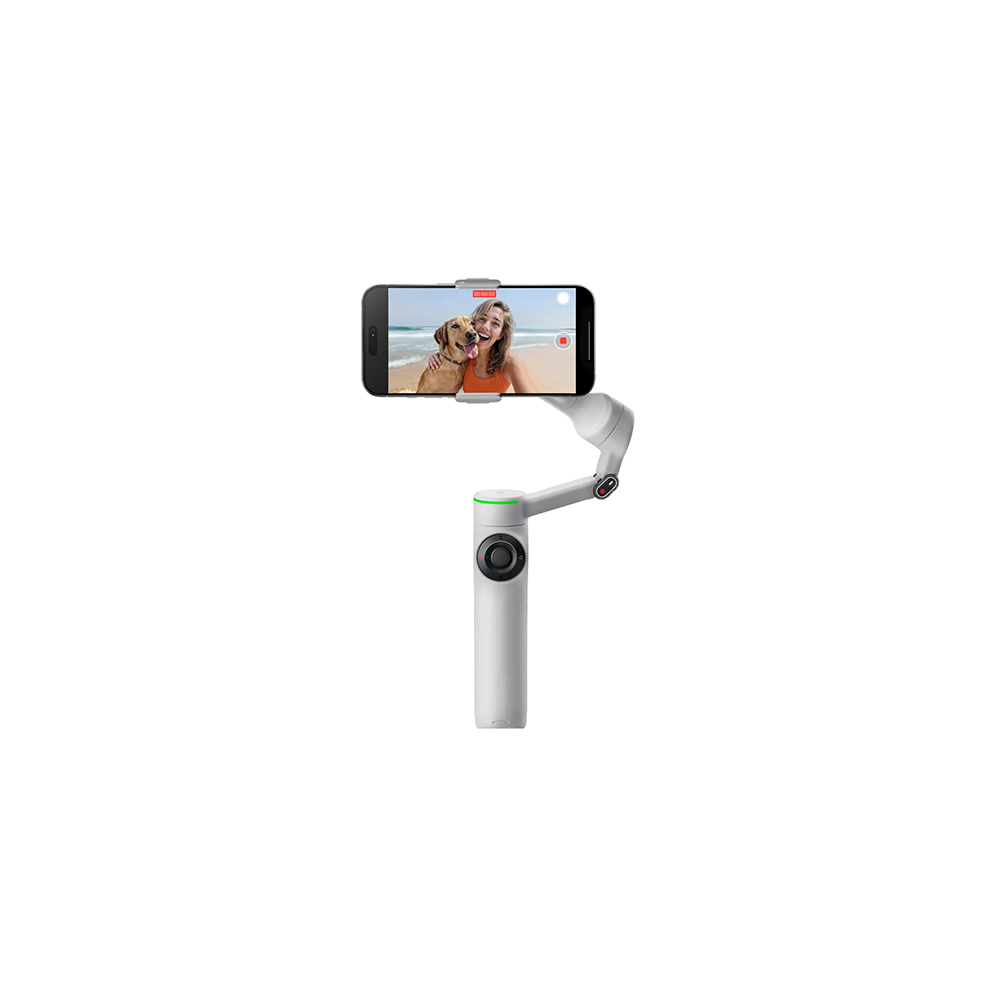
We’ve been talking about the best performers, but we know that may be a bit overkill for many of you. The Insta360 Flow 2 Pro is still very capable, but prioritizes portability. It is our favorite option if you want something you can take anywhere. It fits in a pants pocket, so you can be ready for smooth video capturing wherever you go.
When folded, the Insta360 Flow 2 Pro measures just 97.9 × 178.4 × 36.7mm and weighs 357g. While tiny, it is pretty mighty and actually comes pretty close to the models above!
The one tricky part is that it’s not cheap at $159.99 for the base bundle, which doesn’t come with the AI tracker. If you want to get that, you’ll have to fork out $179.99 for the bundle that comes with the AI tracker.
Also, some sacrifices had to be made to keep the gimbal small and light. For example, the ergonomics and build quality aren’t up there with the top options. That said, it has some really nifty things going for it. Using it is super simple; it has a magnetic phone holder, it can rotate the full 360 degrees (which is rare for gimbals), and it has a really cool mirror on the back if you want to use the rear cameras and still see how you look. Oh, and this one also has Apple Watch support.
The Insta360 Flow 2 Pro is very portable, but still comes with all the high-end specs.
This one has a conveniently built-in tripod and selfie stick, which is nice for solo recording. The AI tracker does come with a fill light for a more seamless experience with fewer accessories. It can track you regardless of which camera app you use and also supports gesture controls, which is quite convenient.
At this price, we would probably recommend the DJI Osmo Mobile 7P instead, but if you care about portability and want something more user-friendly, it’s hard to beat this one. It is an excellent acquisition for casual vloggers.
DJI Osmo Mobile SE: The best budget smartphone gimbal

- Cheaper than the Osmo Mobile 6
- Small and light
- Better mechanical range
- Added display panel
- Still a bit pricey
- No selfie stick extender
If you like DJI, but would rather not pay the high price of the high-end models, the DJI Osmo Mobile SE is a good option. Truth is, getting the top-of-the-line model is not always the best idea. Many of us don’t need all the fancy features, and if all you want is a simple smartphone gimbal that gets the job done efficiently, this one will only set you back $69.
The DJI Osmo Mobile SE gets some of the best features you’ll find on the bigger brothers. It has 3-axis stabilization, a magnetic design, and a very similar control interface. Not to mention, it has a foldable design and is very portable. It measures only 167 × 108.5 × 46.5mm when folded, and weighs 352g.
The DJI Osmo Mobile SE dumps all the bells and whistles, but performs great and comes at an awesome price.
The battery life isn’t as amazing as the new DJI high-end models, but you still get eight hours per charge.
Of course, you won’t get any fancy features like standalone AI tracking or a built-in selfie stick and tripod. There’s no control wheel, either, but you get a rocker for some added control. That said, you can’t expect advanced features from such an affordable product. Especially one that’s pretty nice, like this one.

Zhiyun CinePeer CQ5: Best gimbal for beginning mobile videographers
- Pretty affordable
- Still very capable
- Supports AI module and fill light
- Very portable
- Features built-in selfie stick rod
- Long 11-hour battery life
- Tripod not built-in
- Base model doesn't come with AI tracker
- Has no magnetic or removable phone holder
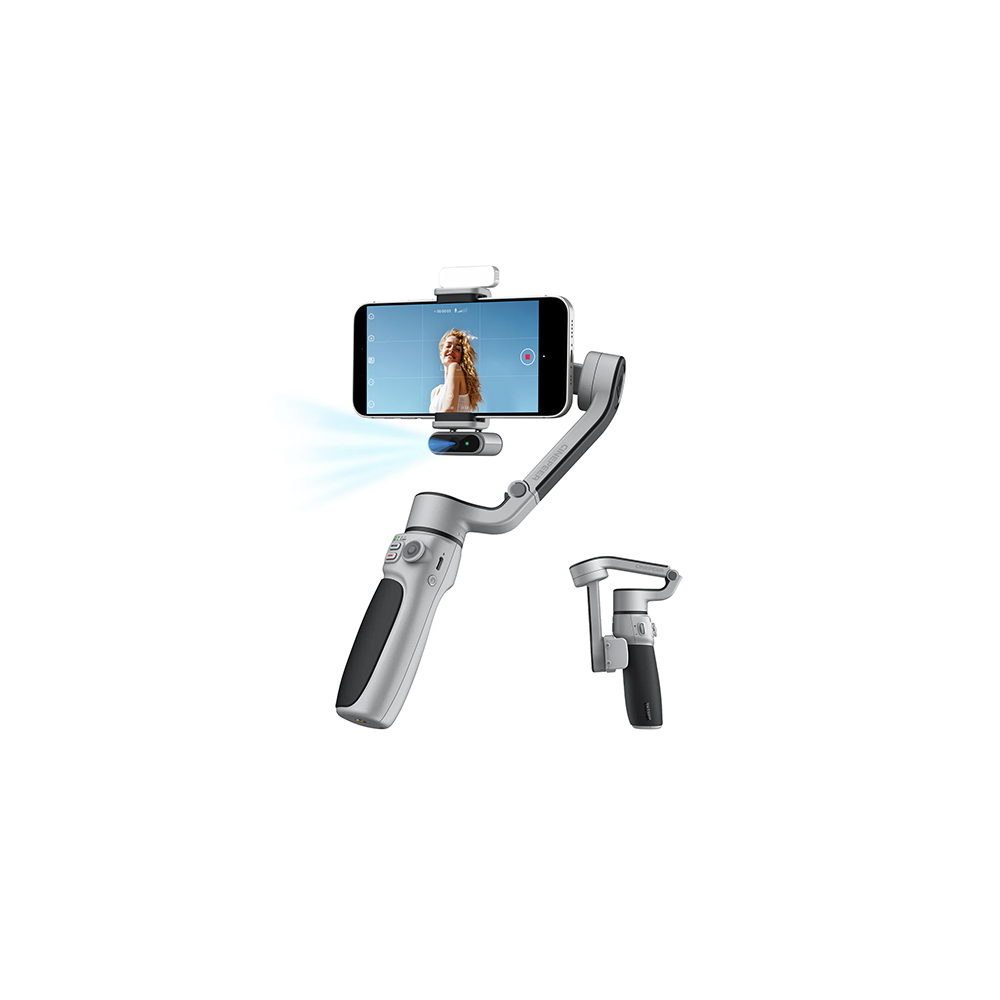
The Zhiyun CinePeer CQ5 is pretty affordable at $99, but it is actually a pretty close competitor to the best options on this list. It’s small and foldable, measuring 188 x 124.3 x 59.3mm when folded and weighing 398g. It’s a great budget option for mobile videographers.
First, let’s talk about the main downside. It has no magnetic, removable phone holder. But hey, if that saves you cash, clamping a phone and removing it every time doesn’t seem like a big issue.
It does feature an AI tracking module, so you can use it to track people without using the official app, and you can opt for any camera application. It’s also nice that it supports voice commands, something that is actually pretty rare. This one is magnetic, and so is the fill light. That said, remember that the base model doesn’t come with these. You’ll need to get the “combo” bundle to get the AI tracker and fil light.
The design is ergonomic and comfortable to use. In addition, it comes with a convenient selfie stick that can extend by 215mm. It will be great for selfies and self-recording. That said, the tripod is removable. Some of us prefer the tripod legs to be built in, but again, you’re paying $99!
Mobile videographers who can appreciate great value per dollar need to look no further than the Zhiyun CinePeer CQ5.
Most affordable gimbals suffer in the battery life department, but this one gets a pretty nice 11 hours per charge.
Considering all factors, we would recommend this to any beginner mobile videographer. It is pretty affordable, has a dedicated AI tracking module, comes with a built-in expandable rod, is pretty portable, and has a great battery life. It’s a great solo gimbal for your vlogs, or for recording your adventures.

What to look for in a good smartphone gimbal

Picking the right smartphone gimbal can be a bit tricky because there are so many out there, and some features are unfamiliar to most users. The obvious factors are size, weight, comfort, battery life, etc. These are basic, but then you have to look into more interesting things, like whether you want 2-axis or 3-axis stabilization, or if you need standalone AI tracking. Do you want a magnetic design? Is it even compatible with your device? How good is the app? Let’s go into the main things to look for below.
- 2-axis vs 3-axis stabilization: 2-axis gimbals smooth out tilt and roll, so they can control movements going up/down and left/right. A 3-axis stabilizer can also control panning. Of course, we recommend 3-axis stabilizers, and all the ones we’ve included in this list fall under this category.
- Portability: Keep an eye on how big the gimbal is and whether it can be folded for easier carrying. The weight also matters a bit. Just keep in mind that smaller and lighter designs usually have to sacrifice something for the reduced space.
- Do you want a magnetic design? Some gimbals have magnetic designs, which can be a really convenient way to interact with them. In some cases, the phone holder can be magnetic. Additionally, sometimes, you can magnetically attach AI modules and fill lights.
- Do you want standalone AI tracking?: Modern gimbals are starting to adopt standalone AI tracking modules. The main benefit is that these don’t require the official app to work properly. This means you can have the gimbal track you while using any app. You can even use it for video calls. If your gimbal doesn’t offer this option, you’ll have to rely on the official app, and these don’t tend to be great.
- Device compatibility: Sometimes, phones can be so large or heavy that the gimbal can’t support them. Check the payload weight limit in the specs, as motors can only handle so much weight. Also, take a look at the clamp width (if the gimbal has one). Your phone may be too wide to fit in there.
Of course, there are other factors like design, customer support, and so on. We have listed the most critical factors, though. If you keep those in mind, you’ll have a smartphone gimbal that meets your needs and significantly improves your video clips.
Thank you for being part of our community. Read our Comment Policy before posting.