Affiliate links on Android Authority may earn us a commission. Learn more.
I've tested the best power stations, and these are my favorite ones of 2026
The proliferation of portable power stations is democratizing power on the go. These batteries are great for keeping your devices powered, but they come in different sizes, prices, capabilities, and port options. How do you know which are the best power stations for your specific needs?
I’ve been testing and researching all the hottest ones. Honestly, I have more power stations at home than anyone has any business keeping around. There are also some others I am keeping an eye on, because there’s no such thing as too much power! Today, we’ll go over our top picks and who they are for. Let’s dig right in!
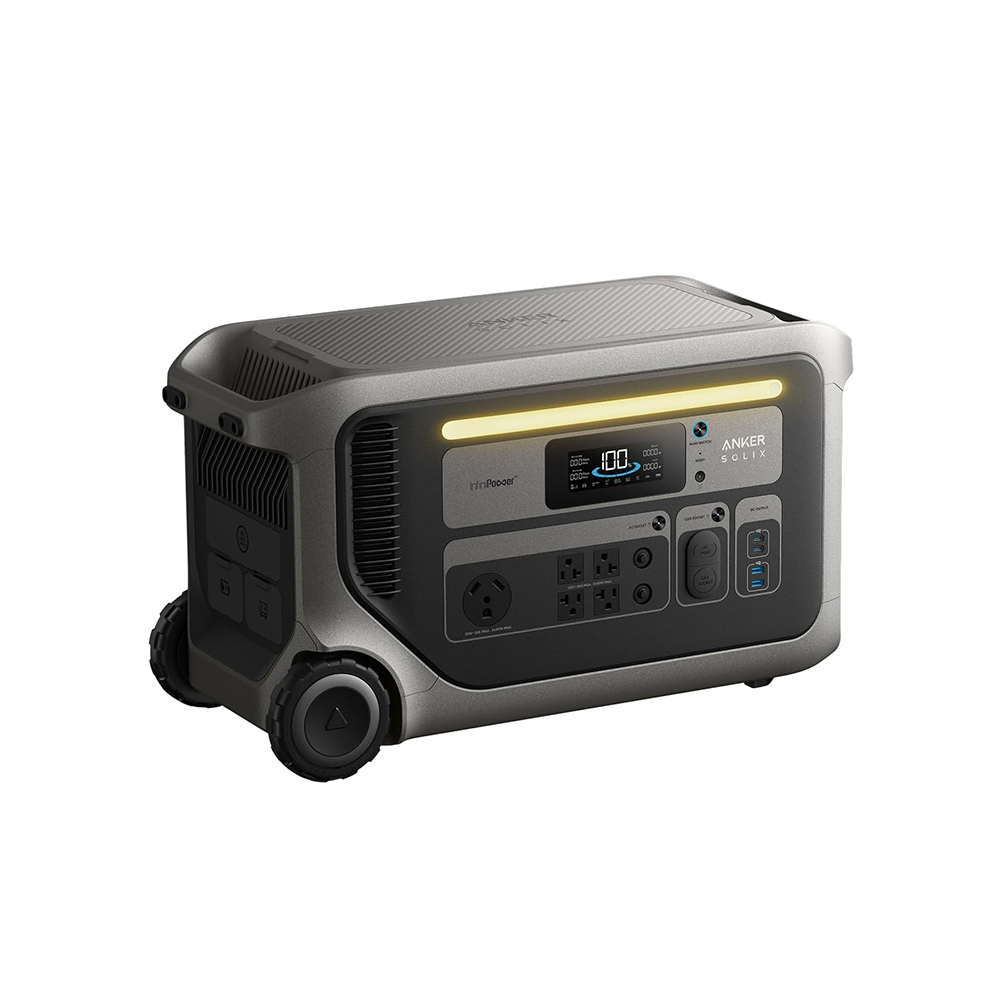
Anker SOLIX F3000: The best portable power station overall
- High-capacity
- Portable despite size
- Impressive output and input
- Can charge EVs and RVs
- UPS support
- Would be better with more USB ports/AC outlets
- Expensive at MSRP (buy in a sale!)
After spending many weeks testing the Anker SOLIX F3000, I have honestly fallen in love with it. In terms of functionality, it is really close to the highest-end models, but also significantly undercuts them in size and price.
This creates an excellent balance for those who want an all-around super-capable power station. It can run most high-power electronics at home, so it’s fantastic for outages and off-grid living. Additionally, it’s portable enough for luxury camping, picnics, or even RV traveling. Its versatility is simply outstanding.
Anker’s top-of-the-line power station is the Anker SOLIX F3800 Plus (which I’ll get to next!). That one has a 3,840Wh battery capacity, measures 27.6×15.3×15.6in, and weighs 136.7lbs. The Anker SOLIX F3000 has a 3,072Wh battery, which is less, but not by too much. In exchange, it has a more manageable 25.6×11.8×14.8in size and weighs 91.5lbs.
Of course, it’s still not as tiny or light as a feather, but I can actually comfortably lift it on my own or easily take it to and from my car, which wasn’t the case with the bigger brother. It has wheels and was designed to be rolled horizontally, which also makes it feel like the center of gravity is lower. In a way, it feels like you are dragging less than you actually are.
Additionally, it has a very capable 2,400W max output through the 20A AC outlets. This is actually the same wattage as the AC outlets in the much more expensive F3800 Plus. Essentially, this means you can power nearly all electronics. I can run high-power appliances like my portable AC, my air fryer, my kettle, and my microwave. All of those average at about 1,000W to 1,800W. As you can see, I have power to spare with this beast!
The Anker SOLIX F3000 Portable Power Station can handle it all, whether at home, on the road, or during your outdoor adventures.
Being such a capable power station, I do wish it had more ports, but the selection isn’t horrible either. You get four AC outlets, two USB-C ports that can reach 100W each, a car socket, and two 12W USB-A connections. Oh, and if you have an RV (or higher-power electronics), it also comes with a TT-30R port, which can output as much as 3,600W.
As you can see, you’re not sacrificing much for the smaller size, and you get much more bang for your buck. I personally believe it is more than enough for most users. It still comes with cool features like UPS, solar panel recharging (up to 2,400W), and a helpful integrated light for those dark nights.
The Anker SOLIX F3000 Portable Power Station can handle it all, whether at home as a backup solution, on the road as an RV power source, or during your outdoor adventures as a great way to run your essential electronics. It even has enough power and capacity in the tank to charge electric vehicles.
If there were such a thing as a perfect portable power station for all needs, this would be it.

Anker SOLIX F3800 Plus: The best portable power station for whole-home backup

- Multiple ports, input, and output options
- Huge portable battery power
- Can connect to RVs/EVs
- Whole-home backup support
- Monster UPS
- Expandable capacity
- Very heavy for portability
- 120V AC ports do not work when connected to Home Power Panel
- Expensive
Now, if you don’t need as much portability, have a bigger budget, and are looking to secure enough power and backup potential for your whole home, then the Anker SOLIX F3800 Plus is definitely the one to get.
Not only is the power station super capable and full of ports on its own, but Anker has created an ecosystem that makes this a great battery to battle power outages, set up off-grid living, and more.
First things first: the Anker F3800 Plus is expensive! It has a retail price of $4,799. It’s a worthwhile investment if you can take advantage of everything it offers, though.
The Anker F3800 Plus comes with a hefty 3,840Wh battery capacity. It can literally charge your phone hundreds of times. Of course, you’re not getting this to charge your phone. In my experience, I can run my mini fridge full-time, and occasionally use my air fryer, kettle, and microwave oven a few times a day. At full charge, this battery can run my electronics for about 3-5 days. Of course, your mileage may vary, as my needs are a bit conservative.
If you do need more battery capacity, you can buy extensions and a second main battery (more on this later). With all batteries and expansions mixed, you can upgrade all the way up to a maximum of 53,760Wh. That is 14 times the capacity of a single Anker SOLIX F3800 Plus unit (and requires 14 total units).
And yes, it can run very powerful electronics. On its own (not using the whole-home system), the AC outlets can output as much as 2,400W. The three USB-C ports can reach 100W, while the two USB-A connections are limited to 12W. Now, this power station comes with a couple of non-traditional ports. The TT-30R and L14-30R max out at 6,000W. And if you connect two batteries together, you can double it to 12,000W!
The Anker SOLIX F3800 Plus can keep you powered through almost any outage or emergency.
To put things into perspective, most HVAC systems use about 3,000W to 5,000W, and those are some of the most power-hungry electronics people usually have at home. Stuff like air fryers, kettles, microwave ovens, and such typically use about 1,000W to 1,800W.
If you decide to set up the whole-home system, you’ll need a power panel, which will connect directly to your home electrical wiring. This takes things to another level, and my colleague Jonathan documented his whole experience with that in the review linked at the top of this section. To summarize it all, the system will automatically switch to battery power if it detects an outage. This happens in just 20ms, so you won’t even notice sudden outages. After some configuration, the system can even avoid recharging from the grid during peak hours, so you can save money!
Additionally, it can connect to solar panels, and you can max this out to 3,200W of solar panel input. If the sun hides away, you can also directly connect it to a gas generator. You can pretty much be covered for all emergencies. And yes, it can also power your RV or electric vehicle directly.
Quite impressive, right? Again, this is an expensive battery, and setting up the whole-home system can also be costly, but it will keep you powered through almost any outage or emergency. And even though it’s a behemoth, it does have a retractable handle and wheels, so if you really need this much power on the go, you can always take it with you.

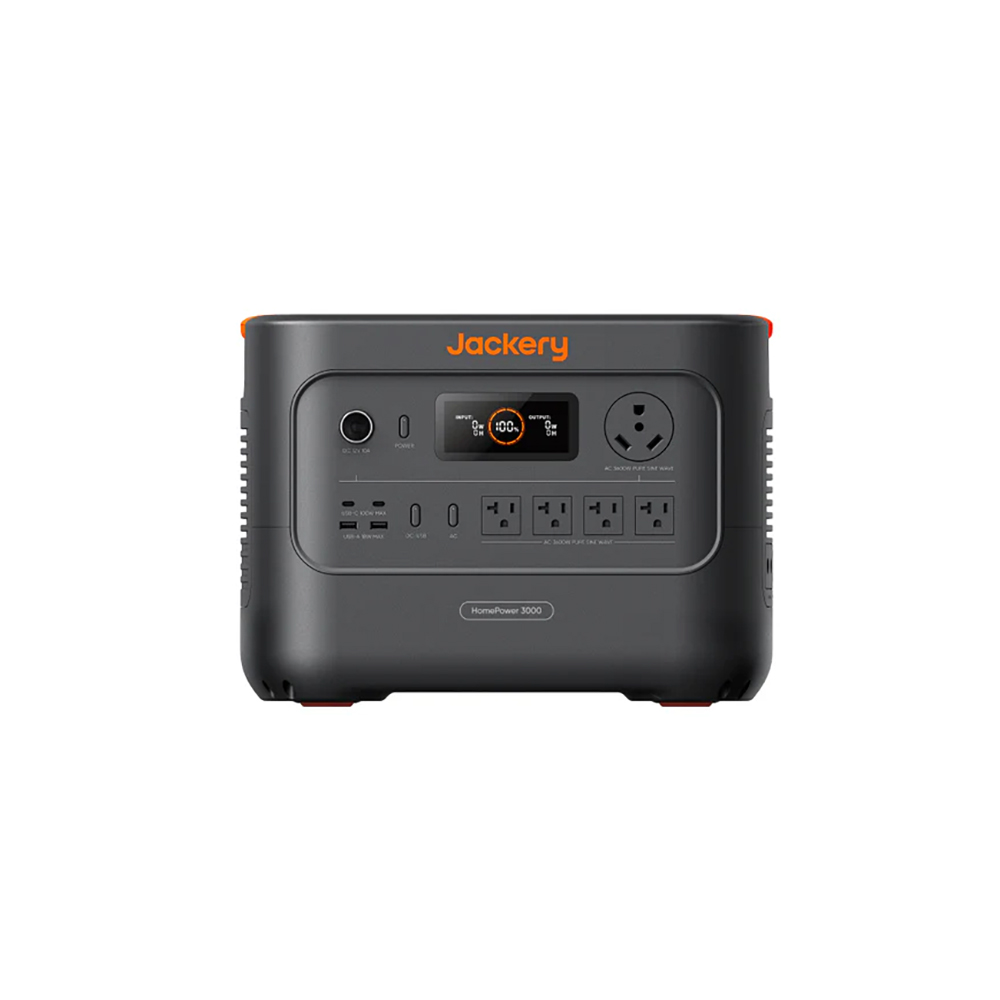
Jackery HomePower 3000: The best portable power station for essential home backup
- Very portable for a 3kWh battery
- High 3,600W power output (7,200W surge support)
- Nice port selection for the size
- Some might still need more power than 3kWh
- Pricey!
The Jackery HomePower 3000 directly competes with something like the Anker SOLIX F3000. It is a smaller yet very capable power station that is comparable in terms of power to the much larger models.
In this case, and as the name implies, the Jackery HomePower 3000 has some optimizations that make it a good home backup solution, but it is still relatively portable and doesn’t cost as much as the big boys, making it perfect as a backup option for your essential appliances and devices.
In this case, we’re looking at a 3,072Wh battery capacity. That is enough power to run something like a mini fridge for 22-33 hours straight. It should also run a modem for up to 62 hours, or a single light for up to 10 days! We’re more familiar with smartphones, so if you want something to go by, it can charge a smartphone about 300 times.
It can also handle much more powerful appliances, though. The four AC outlets can output a maximum of 2,400W. There is also a 30-amp port that can reach 3,600W. Both USB-C ports can handle 100W of output, and the other two USB-A connections are limited to 18W. There’s also a car socket, if you need that.
The Jackery HomePower 3000 will be a lifesaver for keeping your essential electronics powered during outages, and it's small enough to tuck away when not in use.
So, what is it that makes it a nice home power solution? For starters, the output wattage is pretty nice. Most power-hungry appliances in a home run at about 1,000W to 2,000W. These include air fryers, kettles, microwave ovens, and such. Even portable or smaller AC units can use less than the 2,400W limit.
Additionally, you get features like a 20ms UPS. It also supports a couple of 200W solar panels. It weighs 59.52lbs and measures 16.4×12.8×12in, so you can more easily carry it around your home to power different electronics. You can also automate off-peak recharging from the grid, helping you save a bit of money.
All things considered, this is an excellent option if you only plan on running essential electronics during outages. It’s powerful and fast, but portable and small enough to hide away in a closet when not in use.

DJI Power 2000: The best portable power station for RV owners

- Very powerful for its size
- Large 2,048Wh capacity
- Max 3,000W output can power most electronics
- Wide variety of ports, including a 30-amp AC outlet
- Wheels would be helpful
- Solar panel requires a secondary accessory
- Expensive at MSRP
You would think RV owners would prefer a huge, ultra-powerful power station that can really take care of everything. But after talking to a few recreational vehicle owners, I realized their needs are much simpler than you would think. Most prefer something portable that is easy to tuck away and carry around.
It makes sense, as most of these folks don’t usually have serious electronics in their RVs, but do want to keep their essential gadgets going. They also want something they can use to power various camping electronics for outdoor fun. This means that, while power matters, RV owners also want something relatively portable. With all these things in mind, my pick would definitely be the DJI Power 2000.
Technically made for drones, the DJI Power 2000 is a versatile power station that can adapt to anything, just like a seasoned traveler. The battery isn’t massive, but the 2,048Wh capacity is more than enough to run your essential electronics in a pinch. When it’s time to enjoy the outdoors, you can take your electronics to your picnic table and run them surrounded by the beauty of nature.
To put matters into perspective, it can run a small fridge for about 38 hours, a fan for about 18 hours, or a coffee maker for nearly two hours straight. Something simpler, like a lamp, can go for 180 hours before this thing dies! If all you’re doing is keeping your fridge running, the RV lights on, and maybe watching something on your TV, chances are it can last for several hours.
The DJI Power 2000 can keep your RV running, but is still portable enough to carry around the campsite.
Of course, wattage matters, too. This guy maxes out at 3,000W when using the 30-amp port. This one is important for RV owners! Many RVs use a 30-amp port to power the whole trailer. This means you could just hook this up to the RV and seamlessly power everything!
Of course, you also get three standard AC outlets. There are also four USB-C ports; two of them can reach 140W, and the other two max out at 65W. It also comes with four USB-A connections that can reach 24W. If you need some accessories or want to charge DJI drones, there are also two proprietary SDC ports.
If you’re boondocking, it also has solar panel support. And don’t be fooled by the battery’s small size. This thing can take in a whopping 1,800W of max solar panel input. If you’re in a sunny place, the battery will easily recharge using only the sun’s rays. My one annoyance is that connecting the panels to the power station requires a secondary accessory, sold separately.

Ampace Andes 1500: The best portable power station for camping


- Large 1,462Wh battery
- Max 3,600W output
- Plenty of ports
- Works in extreme temperatures
- Relatively portable, but not exactly light or tiny
- Expensive at MSRP (wait for sales)
I have to be honest, this is actually my usual go-to out of all the power stations I have. The main reason is that the Ampace Andes 1500 is mighty enough to run nearly all electronics, but it is also portable enough for me to carry around with one hand. This perfect balance between power and portability also makes it the best portable power station for camping.
The Ampace Andes 1500 measures 7.2 x 7.7 x 13.2in and weighs 36.8lbs. Not exactly tiny or ultralight, but as already mentioned, I can definitely one-hand it (as long as I am not carrying it for miles). It will be easy to take it to and from your trunk, whether at home, a campsite, or a party.
There are plenty of very portable power stations, so you can bet there is something that makes this one special. The thing about the Ampace Andes 1500 is that it is actually quite capable. It has a 1,462Wh battery capacity. This is enough to charge a smartphone about 100 times, but of course, it can do much more than that. During my testing, I was able to power a 200W TV for about six hours. I also used it to run my fridge, kettle, microwave, air fryer, and even powered my portable AC unit with it!
There is very little the Ampace Andes 1500 can't handle, and it is portable enough to carry with one hand.
Yes, it can handle those high-power electronics. The four AC outlets can output 2,400W and support 3,600W surges. To put things into perspective, something like an air fryer uses between 1,000W and about 1,800W. Microwaves and kettles average at around 1,000W. Those are already considered high-power electronics, so there is very little this little guy can’t run.
While the AC outlets are my favorite, the power station also comes with two 100W USB-C ports, four 18W USB-A connections, and a car socket. It even gets a cool little ambient light for those dark nights out in nature. And when it’s sunny, it supports up to 600W of solar panel input.
Another factor that makes the Ampace Andes 1500 the perfect adventure power station is its ability to operate under extreme temperatures. Its operating temperature range is -4 to 113 degrees Fahrenheit, so whether it’s freezing or scorching hot, this thing will keep running.
When at home, it also works great as an ad-hoc backup for outages, too!

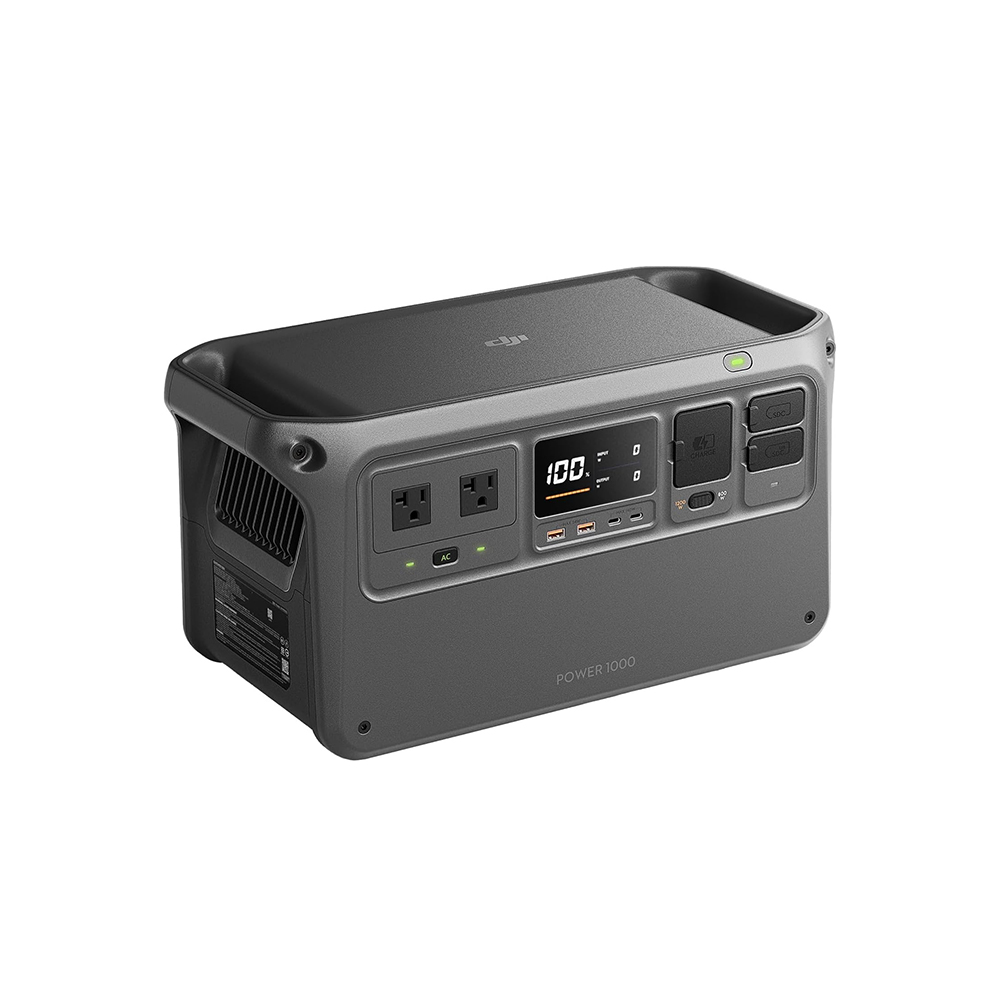
DJI Power 1000: The best portable power station for drones
- Very portable
- Sturdy and simple design
- Dedicated DJI ports
- Capable 2,600W AC output
- Many of you may prefer something with more than 1,024Wh capacity
If you’re a drone pilot, you’re probably using a DJI one. If so, the DJI Power 1000 will be the ideal power station. One would think the bigger DJI Power 2000 is a better option, but that one is bigger, heavier, and much more expensive. It’s also a bit overkill if your primary concern is charging your drone quickly.
The DJI Power 1000 is still capable enough to charge your drone. And if you want some versatility, it can also run most high-power electronics.
The DJI Power 1000 is on the smaller side at 17.64 x 8.86 x 9.06in, and it weighs 28.66lbs. It’s pretty easy to carry around, but it’s still quite capable.
The power station has a 1,024Wh battery capacity. It can charge a drone about 12 times. If you’re going to use it for other purposes, it can also charge a phone about 57 times, or a full fridge for about 20 hours.
The DJI Power 2000 can charge your drone about 12 times, making it the ideal companion for your flying sessions.
It can also run higher-power electronics like kettles, microwaves, and the like. Its max output is 2,600W, with support for 4,400W peaks. The two AC outlets can push those 2,600W. You also get access to a couple of USB-C ports that support 140W, and there are two other 24W USB-A ports. DJI users can also access SDC and SDCA connections, which can handle 400W speeds. These can charge a DJI Mavic 3 series drone in about 32 minutes!
If you need to charge while out in the field, it can take in up to 800W of solar panel input. Recharging via an AC outlet can fill up in under an hour, too.
Drone pilots will love it. Of course, you can always get the DJI Power 2000 if you need more juice.

BLUETTI Elite 200 V2: The best fast-charging portable power station
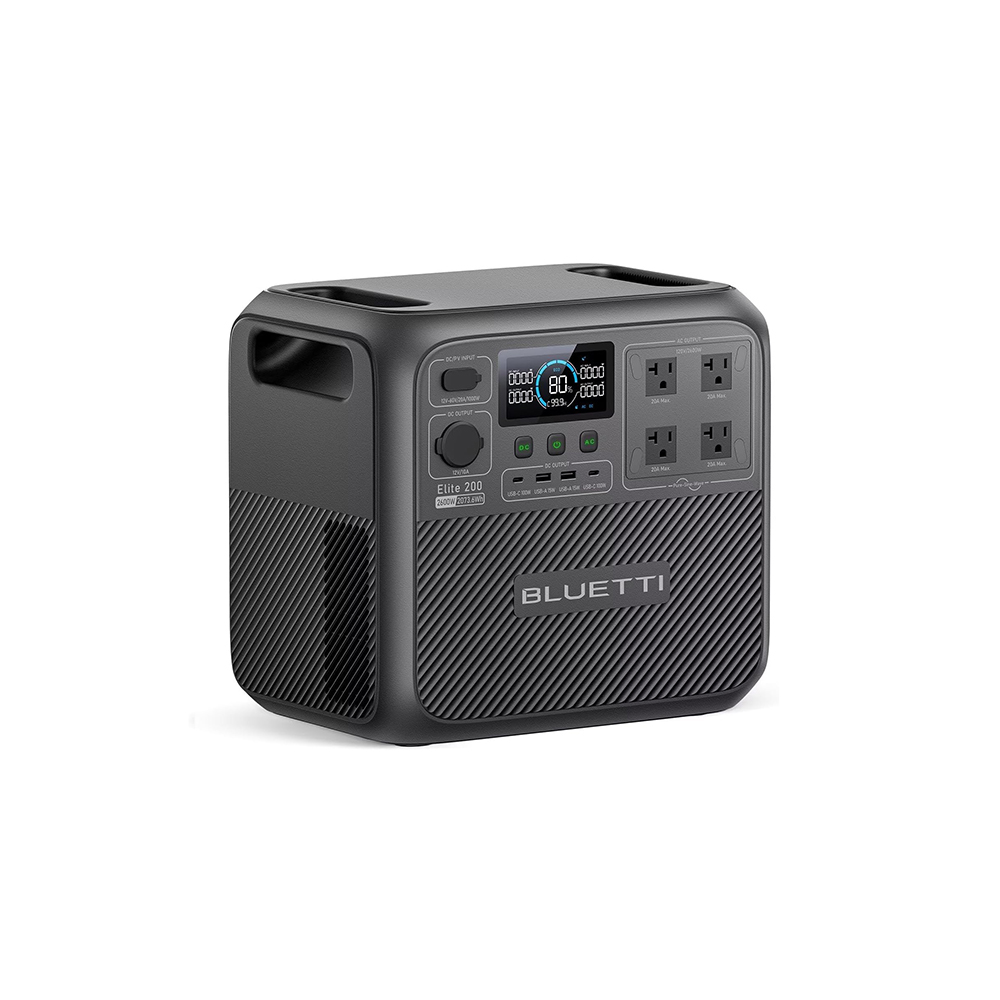
- Charges at 1,800W
- Powerful wattage and large battery capacity for the size
- Comes with a nice selection of ports
- Pricey
Power stations, as helpful as they are, typically have one big, inevitable downside: they tend to take a while to recharge (especially the bigger ones). If you don’t have much time to wait around, you’ll want a power station that can charge exceptionally fast. You also want it to be a capable one, though. Here’s our pick for the best fast-charging power station: the BLUETTI Elite 200 V2.
This power station can charge at 1,800W when using the AC outlet. That’s nothing too special, though. Plenty of power stations can reach these speeds. The trick here is that this one can mix two inputs. Using both AC and DC (solar panels) charging, it can reach as much as 2,400W. This charges the unit to 80% within an hour. A full charge should take about 1.4 hours. Using only solar, you can get a full charge in as fast as 2.4 hours. Even car charging is six times faster than usual, and you can get a full charge in about 4.2 hours.
We also like that it is small and portable. It measures just 13.78 × 9.84 × 12.74in! It has a pretty nice 2,073.6Wh capacity, and the max output is competent at 2,600W. This max wattage can be achieved using the four AC outlets. Additionally, you get two USB-C ports that can push 100W. Meanwhile, the USB-A connections are limited to 15W. It also has a car socket.
When in a rush, the BLUETTI Elite 200 V2 can recharge amazingly fast by combining multiple charging methods.
Like most other power stations listed here, this one can run most appliances. It can power a fridge for over 14 hours, a TV for nearly 17 hours, or a kettle for about 1.6 hours.

Jackery Explorer 5000 Plus: The best high-capacity portable power station
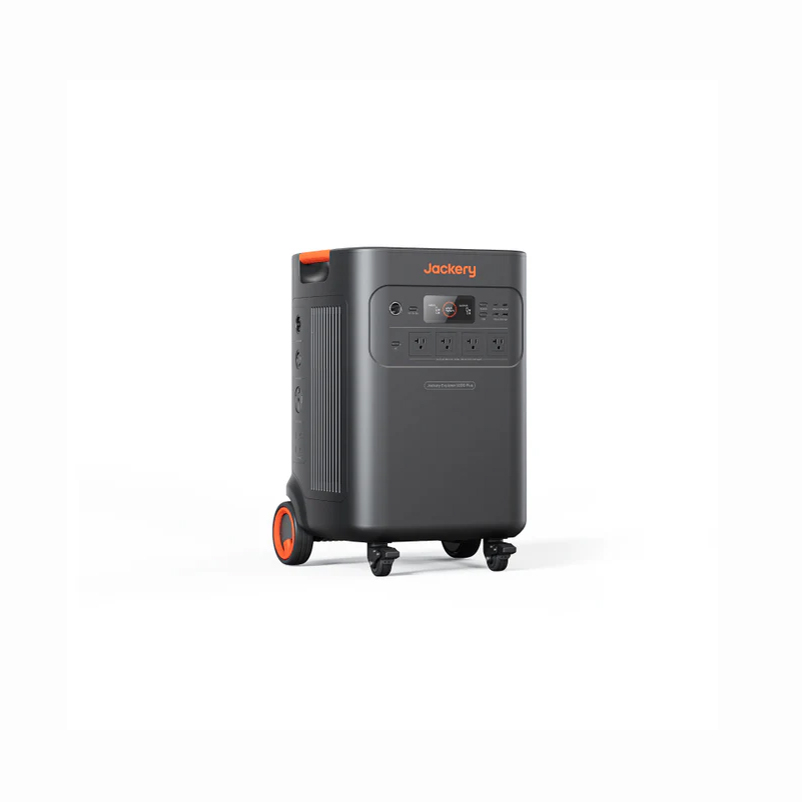
- Impressive 5,040Wh battery capacity
- Powerful 7,200W max output
- 0ms UPS
- Very expensive
- Very big and heavy
If you’re looking for something that can store as much juice as possible, we would recommend the Jackery Explorer 5000 Plus. There have been some competitors with more battery capacity, but they either come from less-known brands, aren’t as good, or are older and pretty hard to find. All things considered, this is your best bet.
The Jackery Explorer 5000 Plus is big and heavy (and expensive). It measures 25.0 x 15.5 x 16.5 inches and weighs 134.5lbs. It’s not easy to drag around or carry (usually requires two people), but it has a huge 5,040Wh capacity. Other “large power stations” usually don’t get close to this much capacity. For example, the Anker SOLIX F3800 Plus is considered a big battery power station with a 3,840Wh capacity. That means the Jackery one has about 31% more juice!
Now, let’s put those numbers into perspective and translate them into human language. That can run a full fridge for about 110 hours or a TV for about 50 hours. In my experience, it has been able to run all my essential appliances for about 3-5 days. Your mileage will vary because I don’t usually require that much electricity. If that’s not enough, you can buy expansion batteries and upgrade to 60kWh (60,000Wh).
Battery capacity aside, this is also an impressive power station. Its max output is a whopping 7,200W, and if you pair it with a second unit, you can double that to 14,400W. With the right setup and using either the 30-amp or 50-amp ports, this thing can power almost anything.
The Jackery Explorer 5000 Plus has a huge battery that can store multiple days of battery power! It's a lifesaver during outages.
It also has four handy AC outlets, which can run as much as 2,400W. Not that you will get this thing to charge smaller things, but it can. You’ll get access to a couple of 100W USB-C ports, two 18W USB-A connections, and a car socket.
If you go all out, it can also work as a seamless whole-home power backup solution. Jackery sells you the transfer switch, which you can install directly to your home wiring. Thanks to UPS support, the system can detect outages and automatically switch to battery power in under 20ms. And considering it has the 30-amp and 50-amp ports, it can even power RVs or electric vehicles directly.
Of course, it has solar panel support. It can handle up to 1,000W of solar panel input. I regularly use a single 500W SolarSaga 500x and get about 500Wh to 1,000Wh of energy daily. I live in a forest with plenty of tree shade around me, so you might get much better results in a sunny place.
This thing is a beast, and it can literally run my whole home for days. If what you want is to store the most juice possible in a single power station, this is your best bet.

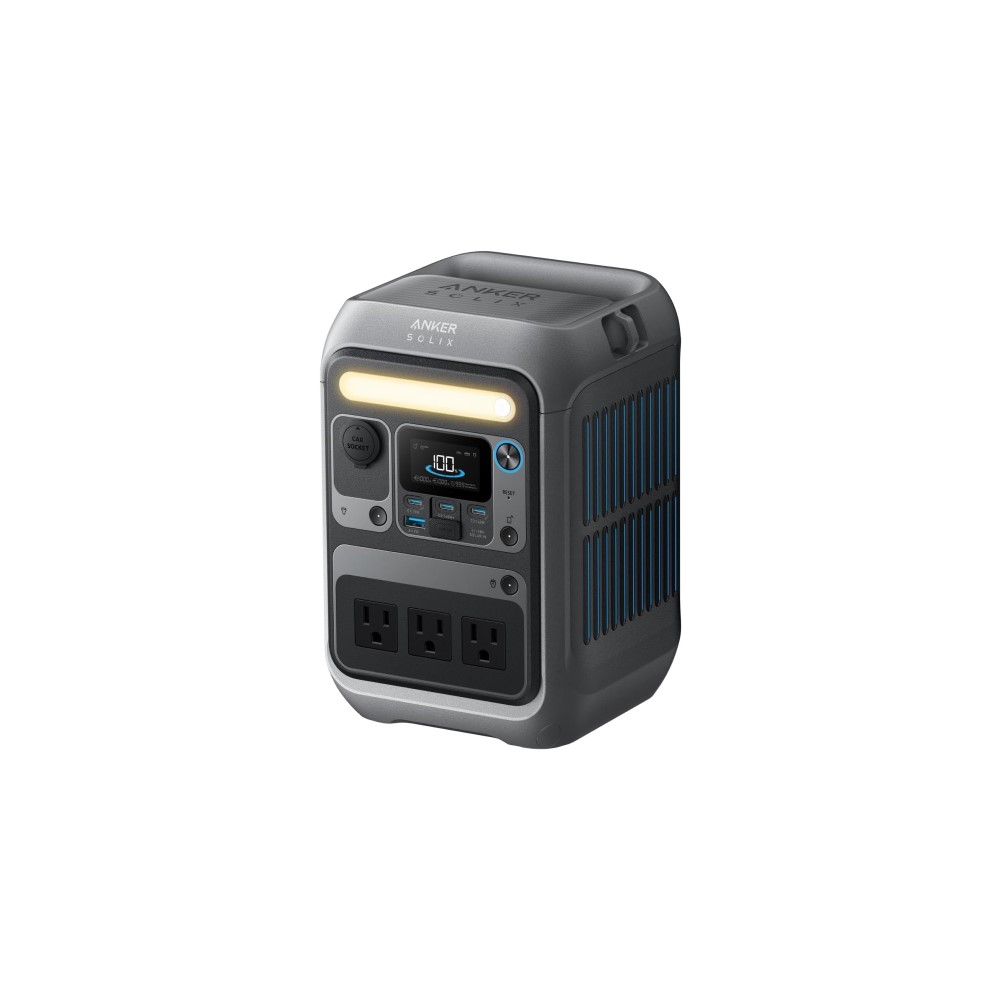
Anker SOLIX C300: The best small portable power station
All the other power stations on this list are impressive, but they are big and heavy. Even the more “portable ones” listed above require some muscle, and you usually can’t really carry even the more portable ones for more than about 10 minutes without breaking a sweat.
If you’re looking for the best small portable battery, the Anker SOLIX C300 is truly portable. You can carry it during long walks and even hikes without an issue.
Let’s talk measurements and weight. The Anker SOLIX C300 is just 6.5 × 6.3 × 9.5in, roughly the size of a milk gallon. It weighs 9.1lbs — about the weight of a milk gallon.
You can carry it around using the built-in handle or a strap. Despite its approachable size and portability, it is actually quite capable. The 288Wh battery capacity is enough to charge a phone about 19 times, or a laptop about four times.
If I had to carry a power station around, the Anker SOLIX C300 would be my companion.
Of course, the size reduction will come with some limitations. This power station has a 300W max output, so you can’t really use it for high-power appliances. That said, 300W is plenty good for many electronics. For example, you can power most TVs, many smaller fridges, electric coolers, lights, projectors, etc.
I love that this one comes with three AC outlets. It also has three USB-C ports, two of which can handle 140W and one limited to 15W. There’s also a single 12W USB-A connection and a car socket.
It also supports solar panel input, just like it’s bigger siblings. You’re limited to 100W here, but this is a much smaller battery. This means it can get from zero to 80% in as fast as 2.5 hours using only solar panels. Car charging should take about the same. Wall outlet recharging accomplishes the same in about 50 minutes.

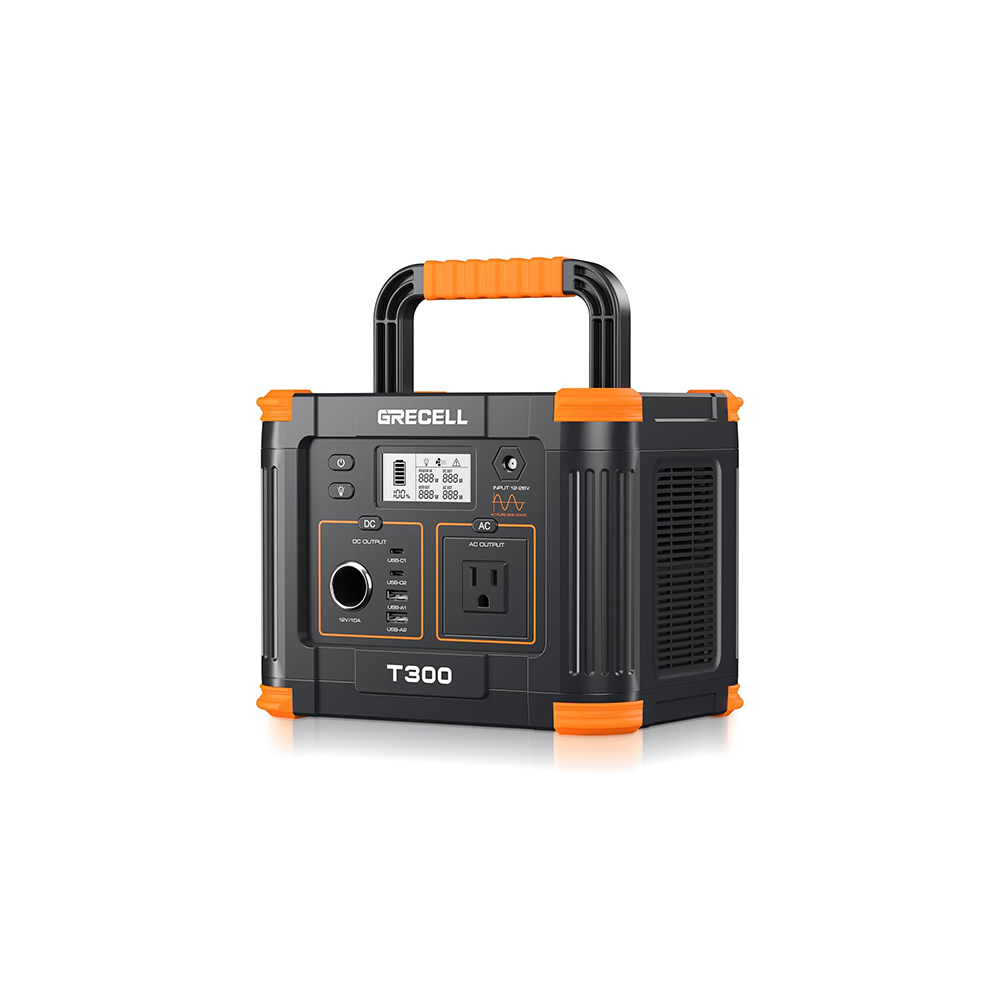
GRECELL T300: The best budget portable power station
- Super light and small
- Capable 230.88Wh and 330W output for the size
- Affordable!
- It comes with an AC outlet, among other ports
- Super bright flashlight
- Fastest USB-C port limited to 60W
- Build quality feels cheaper
- Some may need more power
The GRECELL T300 is the cheapest power station I would still recommend. It’s also a great choice if you want something that is truly portable. The MSRP sits at $199, but we often see it on sale, often for under $130.
This little power station is still quite capable, and it will be a great companion for quick adventures, hikes, and more.
The GRECELL T300 comes with a 230.88Wh battery capacity. That’s still good, even if on the smaller side for a power station. It should still charge a phone about 15-20 times. It has a max output of 330W, which means it can run smaller appliances using the AC outlet.
The newer model has two USB-C ports, one of which can reach 60W and the other 18W, while both USB-A connections are limited to 18W. It also has a car socket.
The build quality isn’t as nice as the others, but the unit is small, light, and comes with rubber corners to help with shock absorption. It measures 9.6 x 6.7 x 6.9in and weighs 10.2lbs.
For under $200 (and often under $130), you really can’t go wrong with the GRECELL T300 if you just want a reliable unit to recharge mobile devices and power less demanding electronics. It’s also super portable, which is nice for campers, hikers, etc. And it does support a solar panel, albeit a low-powered 40W one.

What to look for in a good portable power station

Finding the right power station for your specific needs can be challenging with so many options. There are options for all types of users, and it’s important to know what sets them apart, what each can handle, and so on. Let’s go over some factors you should keep in mind before making a purchase. These are pricey, so you might want to do your homework first!
- Keep an eye on the wattage: I remember going to a party and seeing some family members trying to power a coffee maker with a tiny power station. That was obviously not going to work! Wattage is the main factor to consider here. Different appliances require much more wattage. For example, electronics like microwaves, kettles, coffee makers, and air fryers commonly use over 1,000W. If you have a tiny power station with a 300W output, the appliance won’t turn on. Research how much wattage your electronics require and ensure your power station can handle them.
- How much battery capacity do you need? Of course, battery capacity also matters. Even if your power station can handle an appliance’s wattage, it will be useless if it can only do so for a few minutes. In power stations, battery capacity is typically measured in Wh (watt hours). To put things into perspective, a phone has about 5-15Wh of capacity. A smaller full fridge can use about 300Wh in one hour. A TV commonly uses about 200Wh in one hour. Do some research and see how many Wh your power station can store, and if it’s enough to keep your electronics running for a reasonable amount of time.
- Portability is a factor: How portable do you want your power station to be? Of course, you’ll also have to be reasonable here. A truly portable power station will be light and small, but it won’t be able to do as much as the huge ones. It all depends on what you need. The smaller power stations are usually great at charging phones, tablets, powering small appliances, etc. If you need more power, there are also medium power stations, which can push much more wattage and run high-power appliances. These can be more portable, but not enough to take with you on long walks. Now, if you want true power from a full-home backup solution, you’ll usually have to sacrifice portability by a lot. These can easily weigh over 100lbs! Look into the weight and size of your power station, and also consider whether you will want it to have wheels and/or a handle.
- Port selection: This one usually gets me. Sometimes huge and expensive power stations don’t have many ports, and often the smaller units can even beat them in port selection. The ports I usually care more for are the AC outlets, and I want them to have at least four of these (if they are bigger power stations). Also, look into how many USB-C and USB-A ports you might need and their wattage, too. Slower USB-C and USB-A ports may not be a big deal for charging a smartphone, but they matter once you start plugging in more power-hungry devices like laptops.
- Recharging options: Pretty much all of these can be charged using an AC plug, car charger, or solar panels. You won’t need to worry much about whether your power station supports these or not. What you’ll have to look into is the speeds. How fast can you recharge using an AC outlet? If you want to use solar, how much solar input wattage can the battery take in? Car chargers tend to be annoyingly slow, but some power stations have support for slightly faster speeds. Look into those details before you press the buy button!
- Build quality!: Depending on what you use the power station for, you have to make sure it can take the torture you will put it through. This is especially important if you are to use these for activities like camping, RVing, picnicking, and such. Check out some reviews, or if you can, go and check the batteries out at a local store. Make sure it looks and feels solid. If it has wheels or a handle, check if they wiggle or offer smooth travel. Make sure no door or port feels loose.
- Of course, price: You’ll need to set yourself a budget unless you want to totally overspend on a portable power station. These things can get extremely expensive! And because they are exciting products, it’s easy to get into a rabbit hole of upgrades that seem way too enticing. Once you know what you need, look into multiple options and see if there are any good alternatives. Big brands like Anker and Jackery tend to be pricey, so check out other brands and compare. Value brands include EcoFlow, Ampace, GRECELL, BLUETTI, etc. Also, most of these go on sale pretty often (even the big brand ones). It might be a good idea to be patient and wait for the right deal.
Thank you for being part of our community. Read our Comment Policy before posting.