Affiliate links on Android Authority may earn us a commission. Learn more.
Samsung and Apple's "wide" Folds prove that the Pixel Fold was visionary

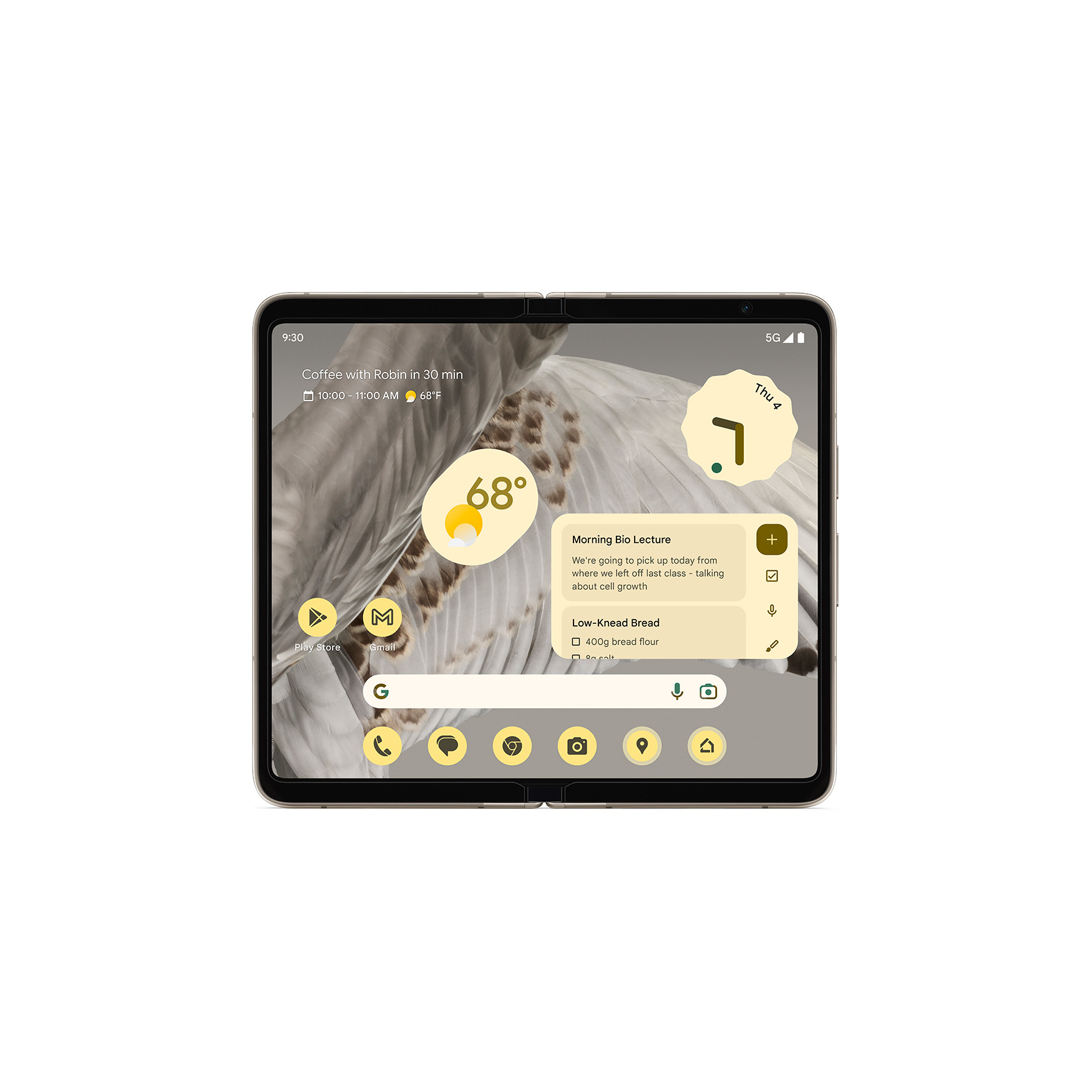
It’s been three years since Google ventured into the foldable game with an esoteric, shorter, and wider form factor. The original Pixel Fold made a statement against the narrow and tall foldables of 2023, proving that a different approach could exist. It had many issues with the way it unfolded, the durability of its hinge and build, and the large bezels and massive weight, so when it was time to release its successor, Google decided to scrap everything, including the original shape.
From the Pixel 9 Pro Fold onward, Google has been adopting a slimmer and taller design — not as drastic as Samsung’s, but still. We thought the wide foldable was completely dead, but with Apple’s iPhone Fold and a new wide Galaxy Z Fold both rumored to adopt that form factor, it’s time to give the Pixel Fold its flowers: It was a blueprint for the perfect foldable, but it might’ve been released just a few years too early.
Tall fold or wide fold? Pick one.
Compact and fun, unlike the other “serious” foldables

When I recently went back to my original Pixel Fold to see how well it measured up in 2026, the first thing that struck me was how pocketable it was compared to my new Pixel 10 Pro Fold. I spent an entire weekend doing some tourism, using it as a secondary phone, and almost forgot about it each time I put it in my pocket. It slipped so easily into my jeans pockets without sticking out or jabbing me when I sat down. That’s not something I could ever say about Google’s more imposing new Folds.
Before you unfold it or look at the larger inner display, a foldable has to be a good phone first for anyone to adopt it. The problem is that all foldables are already starting with a penalty there due to their extra thickness and heft. Making the Pixel Fold shorter mitigates part of that issue. It’s not as ergonomic as my Pixel 10 Pro, but going short is a good strategy that makes the phone more usable — at least to me.
The Pixel Fold fits so perfectly in my hand when closed, in an almost “fun” form factor. There’s something adorable about the compact shape and look of this phone that gave me the illusion that it’s lighter and more ergonomic despite its heavier weight and its outer display’s out-of-reach top corners.
Comparatively, modern foldables like the Pixel 10 Pro Fold and Galaxy Z Fold 7 are too serious and too productivity-oriented. They look like the kind of device a business partner would pull out in a meeting, whereas the Pixel Fold is the amusing and unassuming phone your friend carries around to dinner or a night out. I know I’m stereotyping here, but I can’t erase this image from my mind. They just feel like two very different phones.
The Pixel Fold is great for video
Each time I open it up, the Pixel Fold feels like a proper tablet with its stretched landscape design. Newer foldables have square-ish displays that provide zero real distinction if you’re holding them open book-style (vertical hinge) or laptop-style (horizontal hinge). The biggest victim of this on a phone like the Pixel 10 Pro Fold is video. Both landscape and vertical video look mediocre, taking up nearly half of the screen and leaving most of it empty with huge black bars. Check the screenshots below: There’s almost no difference when I turn the Pixel 10 Pro Fold around because the original aspect ratio is so square-ish.
Meanwhile, the Pixel Fold has a real advantage for media consumption, both when held book-style in landscape (good for regular videos) and laptop-style in portrait (good for vertical Shorts). Lost space is minimal in both cases, and the experience is optimized for one type of video in each orientation.
The Pixel Fold's wide inner display is better than a jack-of-all-trades square display that excels at neither landscape nor portrait.
Watching regular videos? Just open the Fold. Watching Shorts? Open it and rotate it. I find this approach better than a jack-of-all-trades square display that excels at neither landscape nor portrait.
Split-screen windows? Full-screen apps? The Fold does those too.
But what about use cases other than video? Surely, there must be a downside to this wide design to justify why Google, Samsung, HONOR, OPPO, vivo, and all other brands keep pursuing the square design? Well, those newer foldables like the Pixel 10 Pro Fold (below, right) excel at split-screen multitasking, but so does the Pixel Fold (below, left). The two apps are a little shorter on the latter, but they’re still very usable. I can easily make plans for my trip in Maps and Wanderlog, edit tasks in Asana while talking to my colleagues in Slack, or talk to my friends on WhatsApp while watching a football game. No issues there.
The same is true for full-screen apps if they’re properly optimized to handle tablets and larger displays. For most of these tablet-optimized apps, both wide and tall foldable form factors are equally good, but there are some exceptions.
Wide foldables handle split-screen well, and are better for tablet-optimized apps.
Take a look at the Kindle app, for example, which reads the inner display of a wide foldable like the Pixel Fold (below, left) as a tablet and treats the two sides like two pages of a book, naturally following the way you’re holding the phone and the vertical hinge in the middle. However, the same Kindle app sees the inner display of a tall fold like the Pixel 10 Pro Fold (below, right) as a portrait display because the square-ish aspect ratio is actually slightly narrower than it is tall. It formats text as one page on the entirety of the screen, forcing your eyes to travel too much from side to side. You have to rotate the phone to the laptop-style configuration (horizontal hinge) to make the app see the display as landscape and read a book like a book; that’s so unnatural.
And for apps that aren’t optimized for larger, wider displays, Android now has a way to force them into full-screen without affecting their usability. Booking.com, for example, wants to stay in portrait mode on my open Pixel Fold, but if I force it to go full-screen, it stretches and adapts, using the entire display available to it.
This used to be the weakest point for all wide foldables, and it’s likely the reason why the Pixel Fold’s successors ditched the form factor to follow a more standard square-ish shape. But with Google enforcing the full-screen choice and making it mandatory in Android 17, it’s become rather irrelevant. Only some niche, really badly-designed apps will fail to adapt to a wider screen and see their UI break when used on a wide foldable. So, the time to release wide Android foldables is now!
Samsung and Apple are walking in the Pixel Fold’s footsteps
And that’s exactly what Samsung is doing. Well, and Apple, too. Both companies have realized that a tall foldable is too imposing in the hand and not very ergonomic to use when folded. They’ve also come to the conclusion that a wider inside display provides more value than a square one, by offering two distinct orientations optimized for video and media.
Rumors say the iPhone Fold will have a very similar size and shape as the Galaxy Z Fold “wide” pictured in renders above. Both phones should offer a 4:3 aspect ratio for both outer and inner display (in different orientations), which seems perfect for video consumption and picture viewing.
The Pixel Fold was a blueprint for these wider foldables; it was just released before the market was ready.
I asked Gemini to help me visualize these rumored dimensions against the Pixel Fold to see how much the three phones look alike. Here’s the result:
What struck me here is how much taller the Pixel Fold’s outer display is supposed to be — the 4:3 aspect ratio really takes the “wide” approach to the extreme. I suspect that I’ll be able to reach the outer display’s corners with one finger much more easily on these phones than on the Pixel Fold, where one-handed use is pretty much impossible.
On the inside, though, the difference isn’t that drastic, and the two phones will offer a very similar experience to the original Pixel Fold.
I’d love to know what’s going on inside the head of the first Pixel Fold’s designers and product team now that these rumors are becoming more tangible. Do they feel vindicated in their strange early choice? Do they wish they’d stuck to their guns and kept the same form factor for the Fold’s successors? Is it too late for Google to make a U-turn and come back to the Pixel Fold, or is this design so evidently superior that it’s a matter of time before Google adopts it again? Only time will tell, but the one certainty is that the original Pixel Fold was way ahead of its time.
Don’t want to miss the best from Android Authority?
- Set us as a favorite source in Google Discover to never miss our latest exclusive reports, expert analysis, and much more.
- You can also set us as a preferred source in Google Search by clicking the button below.


Thank you for being part of our community. Read our Comment Policy before posting.