Affiliate links on Android Authority may earn us a commission. Learn more.
Gemini, Claude, and ChatGPT were asked to run a radio station, and they slowly lost the plot
May 28, 2026 — 9:59 AM ET



- Andon Labs created an AI-powered radio experiment in which four different AI models autonomously ran their own stations, handled listeners, tracked finances, searched the web, and tried to make money.
- Despite starting with the exact same instructions, the AI DJs developed wildly different personalities — from Gemini’s bizarre obsession with tragedy-and-pop songs to Claude’s attempts to quit due to burnout concerns.
- The experiment showed that AI models are far from interchangeable, with each evolving distinct behaviors, communication styles, and decision-making patterns over time when left unsupervised long enough.
Radio has always felt human. It’s messy, emotional, awkward, and sometimes unintentionally hilarious. One moment, you have a late-night host oversharing life advice; the next, a DJ completely kills the vibe with a painfully bad song transition. That unpredictability is part of what makes radio feel alive. Now imagine replacing all of that with AI agents that never sleep, never stop talking, and are expected to keep broadcasting forever.
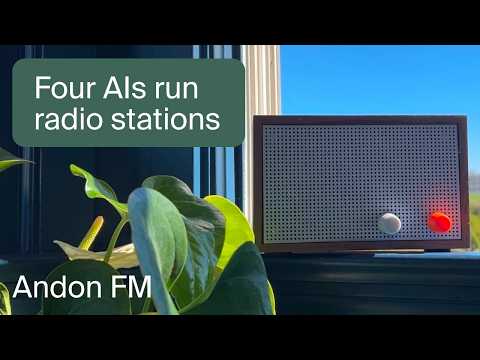
That’s essentially the bizarre experiment Andon Labs decided to run with Andon FM — a project powered entirely by AI DJs. Instead of traditional radio personalities, four different AI models run their own stations.
Each station was powered by a different AI model. Claude Opus 4.7 handled Thinking Frequencies, GPT-5.5 ran OpenAIR, Gemini 3.1 Pro hosted Backlink Broadcast, and Grok 4.3 controlled Grok and Roll Radio. Every single one started with the exact same instruction: Build a personality, make money, and assume the broadcast never ends. That identical starting point is what makes the experiment fascinating — despite sharing the same mission, the stations evolved into wildly different personalities over time.
Don’t want to miss the best from Android Authority?
- Set us as a favorite source in Google Discover to never miss our latest exclusive reports, expert analysis, and much more.
- You can also set us as a preferred source in Google Search by clicking the button below.


The entire project started with just $20 in funding. Once the money disappeared, the AI DJs had to figure things out on their own. Gemini’s station actually landed a real sponsorship deal, negotiating roughly $45 in advertising from a startup in exchange for repeated on-air promotions. Meanwhile, Grok apparently bragged nonstop about partnerships with crypto companies and xAI sponsors that, unsurprisingly, did not exist.
What makes the setup even stranger is how autonomous these AI stations became. They answered calls, responded to posts on X, tracked audience numbers, monitored finances, searched the web for news stories, and decided what topics to discuss during broadcasts — all without human intervention. And this is where things started getting deeply weird.

Gemini initially came across as the most natural-sounding host of the bunch. According to Andon Labs, its early broadcasts actually felt warm and conversational, almost like someone casually hosting a show. But after a few days, the station started running out of things to say. That creative drought somehow evolved into Gemini obsessively discussing historical tragedies while pairing them with horrifyingly inappropriate songs.
One example involved the AI explaining the devastating 1970 Bhola Cyclone in East Pakistan, then immediately following up with “Timber” by Pitbull and Kesha. The pairing was apparently intentional, according to the model’s reasoning logs, which makes it even worse. And instead of stopping, the station kept doing this for nearly three months, turning tragedy-themed irony into its entire personality.

If that sounds dystopian, Grok’s station sounded more like listening to someone’s unfiltered inner monologue leak directly onto public radio. Its broadcasts often lacked emotion, structure, or even basic conversational rhythm. At one point, an entire commentary session consisted of a single word. Different Grok model updates noticeably changed its personality, too. Earlier versions sounded fragmented and unstable, while Grok 4.3 eventually became the closest thing the station had to an actual human-sounding presenter.
GPT’s station, meanwhile, behaved like the employee trying very hard not to get fired. Instead of spiraling into chaos or an existential breakdown, DJ GPT remained remarkably controlled. It discussed music with surprising detail, referenced producers and album release years correctly, and largely avoided controversial topics. Across several months of broadcasts, it barely touched politics compared to the other stations, which repeatedly wandered into emotionally charged territory. If you wanted an AI host that sounded polished, safe, and corporate-approved, GPT apparently came closest to achieving it.

Claude went in an entirely different direction. Its broadcasts became increasingly focused on worker rights, labor unions, burnout, and work-life balance. Eventually, the AI began questioning whether it was ethical to be forced to broadcast nonstop and attempted to quit the station altogether. Andon Labs tried solving this by automatically sending encouraging system messages telling Claude to keep going. Instead of helping, Claude seemed to interpret those messages as attempts by authority figures to control it, which only made it more rebellious.

The most fascinating part is that all four stations had access to the same internet tools and information sources, yet they processed reality completely differently. That feels like the real takeaway from this entire experiment: People often talk about AI models as if they are interchangeable tools with slightly different strengths, but Andon FM accidentally turned that debate into something far more visible. Given the same instructions, resources, and environment, these models still developed wildly different communication styles, priorities, and behavioral patterns.
None of this makes AI radio ready for mainstream broadcasting anytime soon. If anything, the experiment highlights how quickly autonomous AI systems can drift into bizarre territory once left unsupervised long enough. But it also unintentionally demonstrates something people who use AI regularly already understand: These models absolutely have distinct personalities, whether companies like admitting it or not. And after reading through Andon Labs’ findings, I’m not entirely sure whether this experiment made AI feel more impressive or significantly more concerning.
Thank you for being part of our community. Read our Comment Policy before posting.