Affiliate links on Android Authority may earn us a commission. Learn more.
Android flagships could soon pack massive 10,000mAh batteries, thanks to iPhone's battery tech
Sep 25, 2026 — 9:09 AM ET



- A new leak suggests Chinese Android OEMs (likely Xiaomi) are looking to adopt Apple’s rigid, steel-cased battery design to replace traditional soft-pouch batteries.
- Android brands are looking to combine steel-cased battery design with stacked-cell battery technology, aiming for 9,000mAh to 10,000mAh capacities on future flagships.
- While rigid steel casings eliminate the extra clearance needed to accommodate potential cell swelling, they add physical weight and impose tight internal assembly constraints.
Upcoming Android flagships might soon deliver better battery endurance, both physically and in terms of battery life. According to a new leak, Android manufacturers are actively experimenting with steel-cased batteries paired with stacked-cell technology to push energy density to as high as 9,000mAh or 10,000mAh.
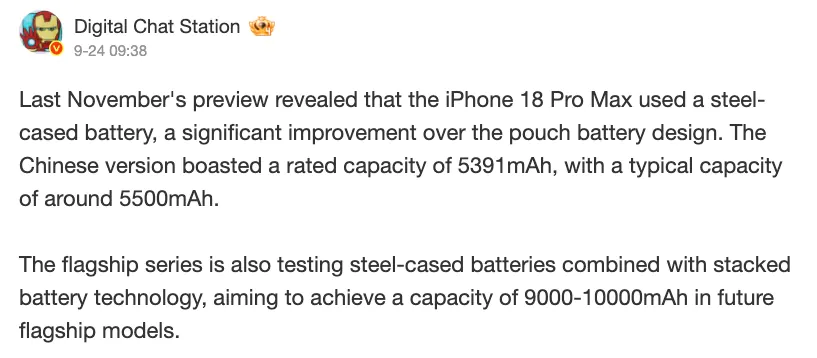
The revelation comes courtesy of reputable leaker Digital Chat Station on Weibo. Highlighting Apple’s continued use of steel-encased battery cells on the iPhone 18 Pro Max, which reportedly pushes the rated capacity to 5,391mAh (with typical capacity hovering around 5,500mAh), the leaker notes that a major Chinese smartphone maker (most likely to be Xiaomi, based on Digital Chat Station’s post format) is testing a similar steel-shell architecture. Combined with stacked-cell manufacturing, the brand could aim to deliver 9,000mAh to 10,000mAh batteries in future top-tier flagship devices.
Metal-cased battery enclosures first gained widespread attention in smartphones when Apple adopted an aluminum casing for the iPhone 16 Pro’s battery, as highlighted in early teardowns.
Traditional soft-pouch batteries rely on softer aluminum-laminated films, which require extra internal clearance to account for cell swelling and offer limited thermal dissipation. In contrast, a rigid aluminum shell allows the manufacturer to pack the cells more tightly, improve passive heat dissipation across the chassis, and safely maximize usable internal volume within the phone, with less tolerance needed for swelling hazards.
A rigid steel shell takes it a step further by providing greater rigidity while allowing for a thinner enclosure. We first saw this on the iPhone 17 Pro and iPhone 17 Pro Max, and it continues with the iPhone 18 Pro series.

When paired with stacked-cell technology (where the cathode and anode layers are laminated and stacked in zig-zag sheets rather than rolled like a traditional jelly roll), internal resistance drops while energy density climbs significantly.
While Chinese OEMs have aggressively expanded battery sizes past 6,000mAh using silicon-carbon anodes, jumping toward the 10,000mAh threshold would be a generational leap for flagship devices. The newly released Xiaomi 18 Pro Max uses an 8,500mAh battery in China, which is already impressive by itself, given the camera tech and the rear display it packs — and you can imagine just how much of a leap it would take to reach the 10,000mAh mark on a proper top-tier flagship.
If these tests pan out, users could realistically see even better multi-day battery life without sacrificing the phone’s structural integrity, thermal stability, or creating a battery hazard. However, steel adds weight, and accommodating a cell that large will test internal packaging limits.
Apple has popularized steel-encased batteries, but we will have to wait and see which Android OEM manages to bring a 10,000mAh steel-cased battery flagship to market first. I wouldn’t be surprised if they needed to pair it with their own implementation of Apple’s Prepare to Ship feature, too.
Thank you for being part of our community. Read our Comment Policy before posting.