Affiliate links on Android Authority may earn us a commission. Learn more.
I tried Motorola's first Wear OS watch since 2019, and I already have a big concern
Sep 3, 2026 — 12:00 PM ET
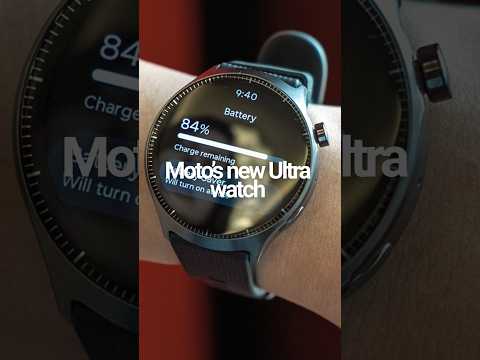

A while back, we asked Motorola to bring Wear OS back. After years of watching the company drift further away from the operating system while Google, Samsung, and others pushed Wear OS forward, it seemed like the obvious thing to do. Well, Motorola finally listened.
Would you buy Motorola's new Moto Watch Ultra?
I got some hands-on time with the company’s new Moto Watch Ultra at IFA 2026, its first Wear OS smartwatch since the Moto 360 launched in 2019. And while Motorola hasn’t reinvented the wheel with its comeback, the Moto Watch Ultra feels like a convincing attempt to get back in the game, albeit with a few curious choices.
A familiar design, but with a more rugged look

Instead of trying to make a thin or even an average-sized smartwatch, Motorola has gone for a big, rugged-looking design that immediately invites comparison with Samsung’s Galaxy Watch Ultra 2. However, with its rotating crown and button as controls, the watch also looks almost identical to the Moto Watch that the company launched in January this year. Only this time, Motorola is finally making everyone happy by returning to Wear OS while keeping fitness tracking powered by Polar.
Motorola is doing something I wish more smartwatch makers would copy.
At 46.26mm wide and 12.1mm thick, the Moto Watch Ultra is certainly not a small smartwatch. Its stainless-steel body gives it that chunky, outdoorsy appearance that has become increasingly popular in the smartwatch market. That puts it firmly in the same visual territory as Samsung’s Galaxy Watch Ultra 2, which measures 47.4mm across. That said, there’s a notable difference when you actually put the watches on your wrist. Motorola’s watch weighs just 51 grams, compared with 61.5 grams for Samsung’s Ultra 2, and that difference is noticeable.
The Moto Watch Ultra looks like it should have some serious heft, but it feels relatively light on the wrist. That makes the oversized design a bit easier to live with, particularly if you’re planning to wear it throughout the day. That said, the watch did look a bit odd on my slender wrist.

Motorola is also doing something I wish more smartwatch makers would copy. It’s putting two straps in the box with the smartwatch. The Moto Watch Ultra comes with two bands, one silicone and one leather, along with its magnetic charging dock. So instead of making you buy another strap separately, the watch gives you two options to begin with. That’s a really nice touch for a device that costs $350. The watch also uses standard 22mm bands, too, so you’re not locked into Motorola’s own accessories.
Coming to the display, the Moto Watch Ultra sports a 1.5-inch pOLED panel with a 466 x 466 resolution, a variable 1-60Hz refresh rate, and a claimed peak brightness of 2,700 nits. There’s also an always-on display and Gorilla Glass 3 protection.
In my short time with the watch at IFA, the interface felt snappy and familiar. The Moto Watch Ultra runs Wear OS 6, so if you’ve used a recent Wear OS smartwatch, there isn’t much of a learning curve. You get access to the usual Google ecosystem, including Google Maps, Google Messages, the Google Play Store, and more.
Everything is fine until you get to what’s powering the smartwatch.
The processor is the elephant in the room

The Moto Watch Ultra is powered by Qualcomm’s Snapdragon W5 Plus Gen 1 platform, paired with 2GB of RAM and 32GB of storage.
On its own, that doesn’t sound particularly bad, but compared to the Wear OS market Motorola is stepping into, that’s not very promising. While the watch felt responsive enough during my brief hands-on time scrolling through Wear OS, opening apps, and moving around the interface, the problem becomes obvious when you put the specifications next to the competition.

Samsung’s Galaxy Watch Ultra 2 and Galaxy Watch 9 use Qualcomm’s newer Snapdragon Wear Elite platform, while the Pixel Watch 5 uses the Snapdragon W5 Gen 2. Google and Samsung’s smartwatches also run Wear OS 7.
Its processor and OS are already behind the latest Wear OS hardware.
So while the Moto Watch Ultra feels perfectly fine today, its processor and OS are already behind the latest Wear OS hardware. The watch is essentially asking you to buy into a big, modern-looking 2026 smartwatch experience while running silicon that dates back considerably further.
That said, I wouldn’t call performance a problem just yet, before we’ve had a chance to properly review the smartwatch. But future-proofing is a big question mark.
Motorola is leaning heavily into fitness

Where Motorola is trying to really stand out is in health and fitness. The Moto Watch Ultra comes with Polar’s fitness and wellness algorithms, including Nightly Recharge, Sleep Plus Stages, Activity Score, Activity Goal, Smart Calories, Energy Sources, Serene, and Active Intensity Zones.
There’s also a Running Coach feature that provides guided running and walking workouts directly from the wrist.
Motorola doesn't have the same health ecosystem as Google or Samsung.
This is an interesting strategy because Motorola doesn’t have the same health ecosystem as Google or Samsung. Samsung has spent years building Samsung Health around its Galaxy Watches, while Google has also been pulling some big punches with the Google Health platform lately. Motorola is essentially letting Polar do the heavy lifting when it comes to fitness tracking.
Whether that translates into better real-world tracking will require us to spend considerably more time with the smartwatch, so I wouldn’t make any definitive claims about accuracy based on my time with the device at IFA.
It has all the smartwatch essentials

The Moto Watch Ultra is fairly well-equipped in terms of health and fitness tracking hardware. There’s heart-rate and SpO2 tracking, an accelerometer, gyroscope, compass, barometer, and an ambient light sensor. There’s also IP68 and 5ATM protection, so you can wear it around water without worrying too much.
Motorola is also finally giving the Moto Watch Ultra LTE connectivity.
The watch packs a sizeable 550mAh battery, and Motorola claims up to two days of active use with the always-on display turned off. The company also says that a 15-minute charge can deliver up to 24 hours of active use under the same conditions.
Motorola is also finally giving the Moto Watch Ultra LTE connectivity through eSIM, making this the first Moto Watch with cellular connectivity. That means you can make and receive calls, send messages, and manage notifications without having your phone with you.
There’s NFC and Google Wallet support, along with dual-frequency GPS, so the watch has the core connectivity features you would expect from a premium Wear OS smartwatch in 2026.
The Moto Watch Ultra also supports Google Gemini, while Motorola is introducing its own Qira assistant on compatible Motorola and Lenovo devices.
All in all, the Moto Watch Ultra is launching into a smartwatch market where the Pixel Watch 5, Galaxy Watch 9, and Galaxy Watch Ultra 2 have moved to newer processors and Wear OS versions. That makes some of Motorola’s spec choices feel strange on a product that otherwise looks and feels quite modern. We’ll obviously reserve our final judgment for a full-fledged review.
Thank you for being part of our community. Read our Comment Policy before posting.