Affiliate links on Android Authority may earn us a commission. Learn more.
Playing Game Boy on an E-Ink screen looks surprisingly good
Jun 30, 2026 — 12:18 PM ET



- YouTuber Wenting Zhang has built a Game Boy emulator using nothing but a 4.7-inch E-Ink touchscreen and the ESP32 chip.
- Unlike conventional E-Ink displays, the Paper Boy S3 features a refresh rate suitable for Game Boy Original titles.
- The Paper Boy S3 has some limitations right now, though the creator has shown what can be achieved with basic hardware and some additional tinkering.
Retro gaming enthusiasts have tons of great options when it comes to emulating Game Boy games today. But every now and then, we come across a concept that pushes the boundaries of what we thought was possible. A YouTuber has done just that by building a Game Boy emulator using an E-Ink display.
We know what you’re thinking: Aren’t E-Ink screens known for their slow refresh rates that make them suitable mostly for turning the pages on your e-book? Well, that is technically true, but YouTuber Wenting Zhang overcame those obstacles by developing an E-Ink driver featuring a high refresh rate (via PC Gamer).
The result is the Paper Boy S3, built using the M5Stack PaperS3 and the ESP32 chipset — a popular choice for E-Ink-based projects, including a tiny DIY e-reader as well as an open-source smartwatch. For the uninitiated, PaperS3 is a development device used by developers to tinker and build experiences for E-Ink displays.
Before bringing this project to life, Zhang spent four years developing the portable E-Ink display with a 60Hz refresh rate, which we know as the Modos Flow.
This experience served as a stepping stone for the Paper Boy S3, turning a 4.7-inch, 960×540 E-Ink touchscreen into a Game Boy emulator capable of running original Game Boy titles such as Pokémon Blue. Support for Game Boy Color isn’t ready yet, while Zhang also mentions some issues with Bluetooth connectivity.
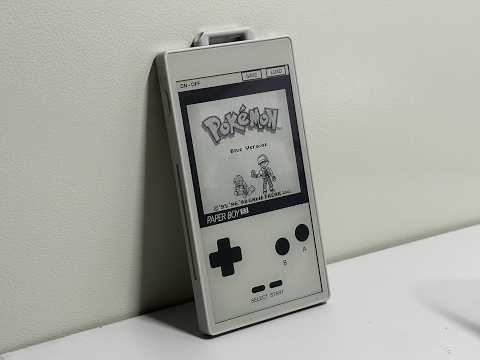
Furthermore, since the M5Stack PaperS3 doesn’t offer massive speakers, Zhang had to get creative to improve the sound on the Paper Boy S3. Check out the video above for a closer look at the project, which also includes all the technical details that brought this project to life.
Even though it’s not perfect, the Paper Boy S3 illustrates that you can build practically anything if you put your mind to it.
The bad news, as Zhang notes in the video above, is that the M5Stack PaperS3 has reached end-of-life status, with the creator remaining hopeful that a replacement or next-gen model will be available soon. This also explains why there isn’t a crowdfunded effort to get it to market, unlike the Modos Flow.
Zhang has uploaded the Paper Boy S3 firmware, enabling enthusiasts with access to the right hardware to take this unique Game Boy emulator for a spin themselves.
Thank you for being part of our community. Read our Comment Policy before posting.