Affiliate links on Android Authority may earn us a commission. Learn more.
Tested in the wild: Best survival tech!
Nov 13, 2026 — 6:20 PM ET
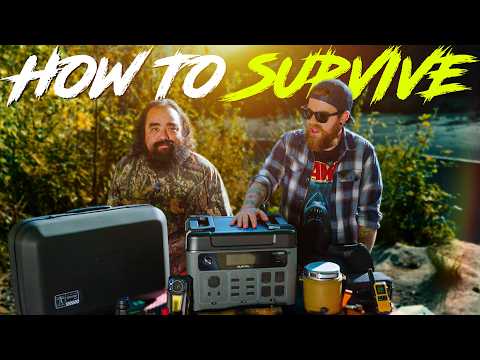


The whole point of camping is supposed to be getting away from technology. We did the opposite. We headed into the mountains with a bag full of outdoor tech to see which gadgets actually earn their place in a camping kit.
We packed gear to keep us powered, online, fed, and hydrated, plus a few things to help out on the trail. Some of it is genuinely useful, some of it is delightfully over the top, and one phone can quite literally light your campfire. Here’s everything we brought and how it held up.
Promoted
Oukitel WP63

Forgot the lighter? With the Oukitel WP63, that’s not a problem. Oukitel bills it as the world’s first rugged phone with a built-in electric igniter. Pop open the small cover at the top, tap once, and a coil heats up that you can hold against tinder to get a fire going. For safety, the igniter has an automatic cooldown of around 10 seconds between uses.
The fire starter is the headline act, but it’s far from the only trick. The WP63 packs a massive 20,000mAh battery that will keep it going for days, and it doubles as a power bank with 18W reverse charging. You can’t even forget the cable, because there’s a USB-C lead built right into the phone. That came in handy when one of our phones started dying at camp.

There’s also a large LED camping light on the back, an 8MP night vision camera for seeing in the dark, and a 3W rear-facing loudspeaker for campsite music. All of that explains why it’s built like a brick: it weighs 629g and measures 27mm thick. Underneath it all, though, it’s a proper Android phone, with a 6.67-inch 120Hz display, that just happens to charge your gear, light your trail, and start your fire.
- Buy at the link below and use code “WP63NEW50” for a discount!
Promoted
Oukitel P2001 Pro

The nearest outlet was miles away, so the Oukitel P2001 Pro portable power station ran the whole campsite. It’s rated for 3,200W across four AC outlets and can handle surges of up to 6,400W. Kettles, coffee makers, microwaves, and portable air conditioners usually need around 1,000 to 1,500W, so it runs that kind of kit with room to spare.
Capacity is 2,048Wh from a LiFePO4 battery. Our hungriest gadget was a 500W cooker, and even that should run for roughly three-plus hours, depending on efficiency and what else is plugged in. Everything else on our trip sipped power by comparison. Alongside the AC outlets, you get two 18W USB-A ports, four USB-C ports (including one 100W PD port), a 120W car socket, and two DC outputs.

Recharging is just as flexible. The P2001 Pro takes up to 1,000W of solar input, can top up from your vehicle on the road, and charges from a wall outlet at up to 1,800W. It also works as home backup, switching over in under 10 milliseconds during an outage, and Oukitel rates the battery for more than 4,000 cycles before it drops to 80% capacity. Just know that “portable” is relative: it weighs about 47 pounds.
- Buy at the link below and use code “PROAA40” for a discount!
Promoted
Ascentiz H Ultra

Yes, we’re at the point where you can strap a powered exoskeleton to your hips for a hike. The Ascentiz H Ultra uses motorized modules at each hip to help your legs move as you walk. Ascentiz claims it can reduce leg effort by up to 40%. We couldn’t measure that on a mountain trail, but we could answer the question that matters: does it make a climb feel noticeably easier? It does, especially on steeper inclines.
Getting the fit right takes a few minutes the first time. The Exo-Belt uses removable metal links to size it to your waist, the hip modules line up with your hips, and pads sit just above your knees. After that, putting it on is straightforward. You can also flip the belt around so the main unit sits at the front, which helps if you’re wearing a big backpack or riding to the trailhead. The frame is titanium and carbon fiber, the whole system weighs about 2.5kg (5.5 pounds) including the battery, and it folds down to roughly A4 size to stash in a pack.

It’s also impressively quiet. Ascentiz rates it at no more than 35dB, so you barely hear the motors working. Ascentiz’s AI OmniTerrain system reads how you’re moving and adjusts assistance automatically, so you never trigger anything step by step. The app lets you pick a mode: Ease for regular assistance, ACC for stronger acceleration support, and Train, which adds resistance if a mountain climb somehow isn’t hard enough. And in an emergency, the battery doubles as a power bank with 20W USB-C output.
We used it for hiking, but the technology gets far more interesting for people who already find getting around difficult. If you’re shopping, Ascentiz also sells the H Pro, which is aimed at everyday mobility and lighter outdoor activity, while the H Ultra is built for longer, more demanding days. The platform is modular, too. Ascentiz’s K module adds powered knee support and impact management on descents, but it isn’t on sale yet; the company says availability will be announced soon.
- From November 19-30th, get the H Pro at $1,099 (originally $1,499); H Ultra at $1,499 (originally $1,999).
- Buy at the link below and use code “ANDROIDA100” for a discount!
Greeshow portable electric water filter

Our campsite sat right beside a glacial stream, but clear-looking water isn’t the same as safe water. That’s where the Greeshow portable electric water filter comes in. Drop the intake hose (with its pre-filter) into the stream, put the outlet hose in your bottle, press the button, and it does the rest. No hand pumping, no squeezing, no waiting on gravity.
Inside is a five-stage filtration system built around a 0.01-micron hollow-fiber membrane. Greeshow rates it at up to 700ml per minute, and in our testing it filled a one-liter Nalgene in about a minute and a half. Everything, including both hoses, packs away into a compact case, so it’s small enough to throw in a day pack.
It runs on a built-in battery that charges over USB-C, with two backups for longer trips: a solar panel on the side and a hand crank. Worst case, you end up standing by a river cranking your water filter for a while, which still beats being thirsty. As long as there’s a water source nearby, it means carrying far less water, and it’s earned a permanent spot in our camping kit.
Nestout Outdoor Cooker

With the power station running, we could do something you don’t normally get to do at camp: plug in lunch. The Nestout Outdoor Cooker (also sold as the Cooker-1) is a compact 500W electric pot that runs from a portable power station or a wall outlet.
After a long day of travel and setting up camp, that convenience is the whole appeal. Propane stoves are great, but you’re forever stirring and fiddling with the heat, and every stove seems to have that one burner knob that goes from simmer to scorched in three millimeters. The Nestout is far more set-it-and-forget-it. We threw in lentil soup and some precooked sausage, got on with pitching camp, and came back to a hot meal. The lid doubles as a plate, too, though be warned: the pot gets pretty hot.
You can get more ambitious if you want. There’s a rice mode, three temperature settings, and a steaming tray for things like dumplings, and you can slow-cook a stew or boil water. Capacity is 800ml, though, so it’s best for one or two people. Boiling a full pot took us about 15 minutes, so it won’t replace a propane stove anytime soon. For soup you can throw in and walk away from, though, it’s exactly what we wanted.
Garmin Fenix 9 Pro

Exploring an unfamiliar trail is a lot less nerve-wracking with the Garmin Fenix 9 Pro on your wrist. We used the 47mm Solar model with inReach. It’s the biggest, thickest watch we’ve worn, but it does far more than most watches.
inReach is Garmin’s satellite connectivity, and it keeps you in touch where there’s no cell signal at all. You get maps on your wrist, navigation over rough terrain, hike tracking, and directions back to where you started. If you’re lost, injured, or need help, holding the SOS button sends a distress signal with your exact coordinates to Garmin’s 24/7 response team, which coordinates help. You can also message people back home through Garmin Messenger and share your live location, signal or no signal. Just note that inReach features require a Garmin subscription plan.

It covers the smartwatch basics, too, with notifications, Garmin Pay contactless payments, a compass, a barometric altimeter, and Garmin’s full suite of health tracking. The case is titanium, and it carries a 10 ATM water rating and is certified for dives down to 40 meters. Battery life is rated at up to 21 days in smartwatch mode, or up to 34 days with solar charging, and the larger 51mm Solar model stretches that to 57 days.
It quickly became our favorite outdoor smartwatch, but it’s a lot of money. If you mainly want to stay safe, the Garmin inReach Mini 3 Plus is a cheaper option. It’s a handheld satellite communicator rather than a watch, but it still offers SOS, messaging, and basic maps.
Starlink Mini

Escaping the modern world is nice. Knowing you can reconnect when you need to is even nicer, especially if your job lives online. The Starlink Mini is about as compact as satellite internet gets, and it’s all you need to get online almost anywhere with a clear view of the sky.
The router is built into the dish itself, so there’s no separate box to carry. The only tricky part is pointing it in the right direction, and the Starlink app walks you through positioning and alignment. The same app handles connected devices, speed tests, and your plan. Speeds depend on sky visibility, weather, network congestion, and your plan, but in good conditions it’s comfortably quick enough for video calls and streaming from a campsite.
We used Starlink’s top-tier Roam Unlimited plan, which costs $175 per month and lets you take the Mini anywhere. If you don’t need unlimited data, there are cheaper Roam plans with 100GB or 300GB of high-speed data.
Olight Baton 4 Premium Edition

The Olight Baton 4 is the flashlight that lives in our pocket. It’s roughly the size of a thumb at 63mm long, yet it puts out up to 1,300 lumens. That’s a lot of light for something this small, and the textured grip keeps it secure in your hand despite its size. A built-in battery indicator means you’re never guessing how much charge is left.
Whether you’re working out what that noise in the trees was or digging for the last cold drink in the cooler, it’s a handy thing to have on you. The Premium Edition adds the best part: a wireless charging case. It works like a charging case for wireless earbuds, except for a flashlight. Drop the light in at the end of the day and it charges, and the case’s own 5,000mAh battery can refill the Baton 4 up to five times. You can even use the light while it’s sitting in the case.