Affiliate links on Android Authority may earn us a commission. Learn more.
TCL CSOT unveils APEX and IJP OLED breakthroughs for the AI era at DTC 2026
Nov 27, 2026 — 2:56 AM ET



A screen has a big impact on how a device feels to use. It determines how crisp text looks on your laptop, how smoothly fast-moving games appear on your monitor, how long your phone lasts on a charge, and whether the person next to you on the train can read your screen. OLED screens, in particular, need a lot of precision to manufacture, which is why they’re most often found only in higher-end phones, laptops, monitors, and tablets.
TCL CSOT, which makes and develops displays for many device manufacturers, is working on a method to build OLED panels by printing the materials onto them, which could help OLED get into more products.
At DTC 2026, its annual Global Display Tech-Ecosystem Conference in Wuhan, China, on November 13, TCL CSOT showcased its latest display tech: inkjet-printed OLED, a 500Hz gaming monitor, a 115-inch 16K screen that shows 3D without glasses, and more. They also took Android Authority on a tour of the Wuhan factory and the t12 production line, where they’re working on the IJP OLED. Here’s what you need to know.
How inkjet-printed OLED works

IJP OLED stands for inkjet-printed OLED. While traditional OLED manufacturing uses processes to deposit organic materials onto the display, IJP OLED uses specialized printers to place those materials precisely where they’re needed. The idea is similar to using a home inkjet printer, but the “ink” is made of organic materials that form a working OLED panel.
Printing the materials this way helps reduce waste and potentially lower manufacturing costs, which is a significant advantage for bringing OLED to a wider range of products in the future.
It also offers a picture-quality benefit. IJP OLED uses TCL CSOT’s Real Stripe RGB pixel arrangement, with separate red, green, and blue subpixels arranged in stripes. This design delivers sharper text and noticeably reduces color fringing around the edges of text and graphics compared with a conventional OLED panel.

With IJP OLED, we can reach 163 PPI on a 27-inch 4K display. For gaming displays, it can reach 218 PPI, with a 0.03 millisecond response time. People read a lot of text on monitors and laptops, so this is a benefit users can see every day.Weiran Cao, Ph.D, General Manager of IJP-OLED Middle Platform of TCL CSOT
TCL CSOT has already begun mass-producing IJP OLED panels, and several partner devices using this tech were featured at DTC 2026. The Lenovo Legion R9000P has a 16-inch IJP OLED panel with a 2,560×1,600 resolution, a 240Hz refresh rate, and 100% DCI-P3 coverage. Meanwhile, Lenovo’s ThinkVision P27UL-40 is the company’s first IJP OLED monitor for commercial use, with a 27-inch 4K display and 99% DCI-P3 coverage. The MSI Prestige 14 AI+ and MSI PRO MAX OLED 271UPJW12 also use TCL CSOT’s printed panels.
TCL CSOT has also introduced two new 14-inch IJP OLED notebook panels. One is less than 0.66mm thick, weighs under 66g, and has a reflectance of less than 1%. The other eliminates the cover glass, using a hardened polarizer with an 8H rating instead, but it still feels like glass to the touch, whether you use a finger or a stylus.
A 500Hz gaming monitor and a 115-inch 3D TV display

TCL CSOT showed off a 27-inch QHD gaming monitor featuring an IJP OLED panel with an oxide backplane, and supporting refresh rates of up to 500Hz. TCL CSOT says it’s the first display to use in-panel compensation for high refresh rates. It helps maintain picture quality and runs in real time in the background, so there’s no need for the periodic power-off cycles used by conventional methods.
Real Stripe RGB keeps edges sharp, with a response time under 1ms. The 500Hz refresh rate is designed for competitive gaming, keeping moving targets in fast-paced shooters crisp and easy to track.
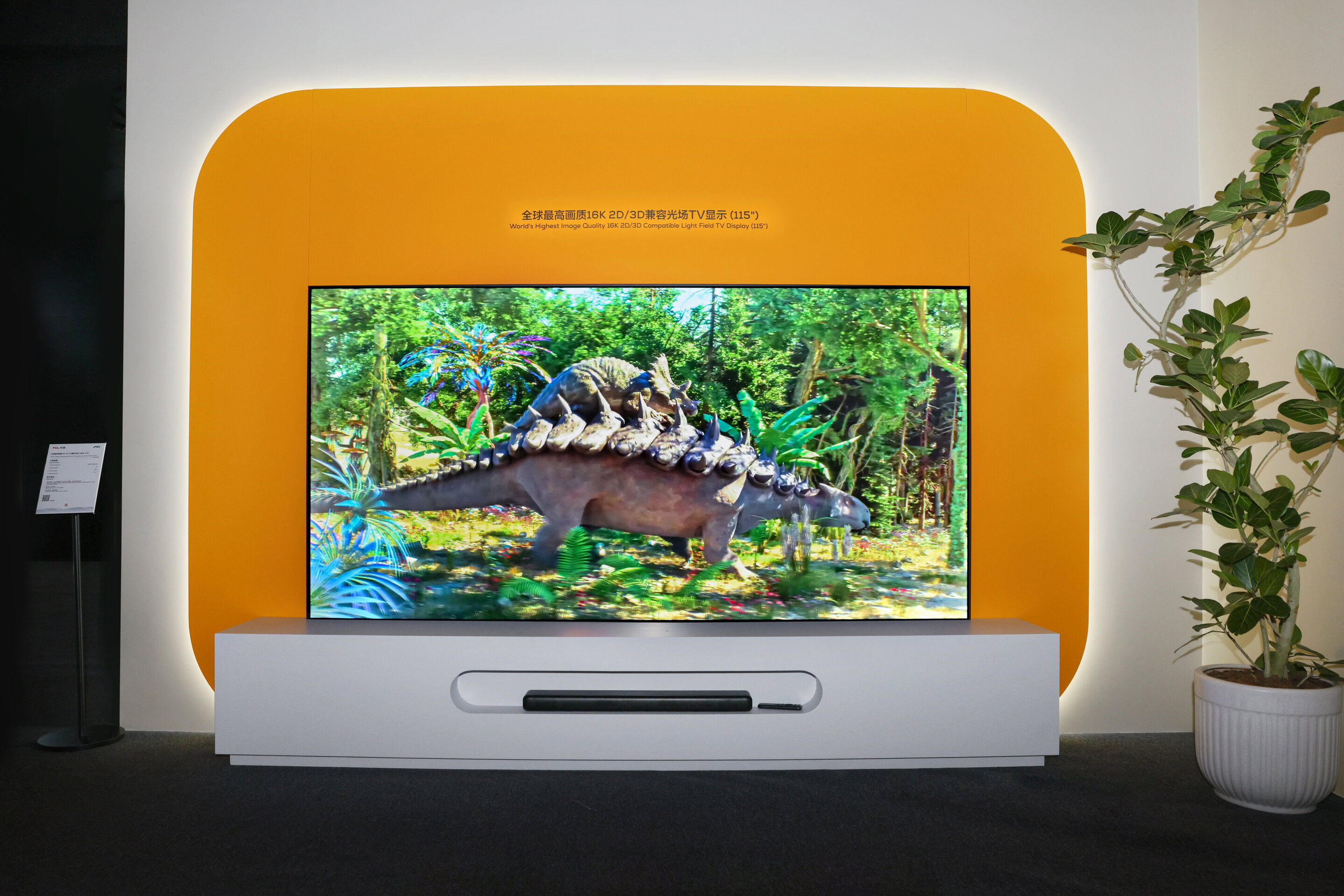
The 115-inch display has a native 16K resolution of 15,360×7,680, and TCL CSOT says it is the world’s highest image quality 16K 2D/3D-compatible light-field TV display. Its light-field optical architecture addresses the viewing-angle limitations of conventional glasses-free 3D, offering a 90-degree viewing angle or more, extended depth of field, and support for multiple viewers, so you don’t have to sit in one specific spot. The 3D light-field resolution reaches up to 8K, and the screen can switch between 2D and 3D, with TCL CSOT claiming there’s no loss in 2D picture quality.
The recommended viewing distance is 2–4m (6.5–13ft), making it well suited for private theatres, digital museums, interactive gaming, and premium showrooms. It’s an impressive display, though it’s unlikely to find its way into living rooms anytime soon.
More efficient and more private mobile displays

The 6.36-inch blue phosphorescent OLED may have been one of the most practical displays at DTC 2026. TCL CSOT says it’s the first smartphone OLED display to use a blue phosphorescent material system, which they say delivers roughly 40% higher luminous efficiency and around 20% lower electroluminescent power consumption at the same brightness.
The display is a major power draw, so the battery-life improvements are definitely exciting. Paired with the larger batteries introduced in newer handsets, more efficient screens could significantly increase the time you can use your device between charges. TCL CSOT is also working to refine materials and manufacturing processes to extend device lifetimes and bring blue phosphorescent displays to more devices.

The World’s First Full-Angle Lossless Privacy OLED Tablet Display(10.95″) helps keep your screen private from people nearby. Its dual-pixel architecture and pixel-level light-path control provide 360-degree active privacy while keeping the view clear from the front.
APEX and AI for Real

All of these technologies are part of APEX, TCL CSOT’s advanced display technology brand, created with picture quality, eye comfort, and sustainability in mind. APEX is built on four pillars: Amazing Display Experience, Protective of Eye Health, Eco-friendly to Build and Use, and Unlimited Imaginative Potential.
AI for Real was another major focus at DTC 2026. TCL’s strategy is to bring AI out of the lab and into everyday life. For TCL CSOT, a key part of that vision is Display for AI — advancing display technology so AI-powered devices can deliver a better experience. Whatever an AI assistant does on your phone or laptop, the screen is where you see the results and respond. That means better displays can make AI features feel more useful in your day-to-day life.
Know more about TCL CSOT at DTC 2026

At DTC 2026, TCL CSOT showed off its progress on several fronts. IJP OLED is moving beyond the demo stage and toward mass production, while gaming panels are advancing toward 500Hz. The company also showcased a 115-inch glasses-free 3D screen, along with new mobile panels that use less power and help keep your screen private. Bringing these efforts together is AI, which is helping TCL CSOT design displays much faster. And the great news is that many of these features are already in everyday use.
TCL CSOT makes panels for other device makers, so you can find its technology in products from a range of brands. IJP OLED is already featured in Lenovo and MSI laptops and monitors showcased at DTC 2026. The other displays are currently technology demonstrations, with no retail timelines announced yet. You can find more information about TCL CSOT’s display technology on its website.